

This page shows the products and features currently planned for the 26.4 release cycle, which begins on 26 October 2026 and ends when the next release begins, which is currently targeted for 4 February 2027. Features are subject to change between now and the end of the release cycle. You may receive these features at different times throughout the release cycle. Remember that you may be required to purchase a license or sign up for a public preview program to access some of them.
Register for the 26.4 webinar.
- Join the webinar for the AMER and EMEA regions
 on 4 November, 10:00 AM EST.
- Join the webinar for the AMER and EMEA regions on 10 November, 12:00 PM EST.
- Join the webinar for the ANZ region on 11 November, 9:00 AM AEDT.
These sessions will cover the coming features in more detail.
 How to Use This Page
All new products and features are shown by default. If you want to see only products and features in your NiCE CXone system, you can clear the checkboxes to remove features you don't need from your display.
Each feature description includes a table that states whether the following details apply to it.
| Customer Request | The feature was developed by customer request. |
| UI Change | The feature introduces changes to the user interface (UI). |
| Breaking Change | For API features only. If your integration uses the specified API, you must update your integration to avoid disruptions. |
| Impacted Versions | For API features only. The versions of the API that were changed. |
| Web or Desktop Studio | For Studio features only. Whether the feature is supported in web Studio, desktop Studio, or both. |
| Availability |
This cell tells you two things about the feature:
|
Learn about the platform requirements and FedRAMP support status for the NiCE CXone apps you use.
What's New in the Online Help
Help Center Accessibility Updates
The Help Center has been updated with accessibility improvements designed to offer a more inclusive experience for users across a wide range of visual, motor, and cognitive needs.
Accessibility
Accessibility Improvements
Many features and apps in NiCE CXone now include significant accessibility improvements designed to offer a smoother, more inclusive experience for users across a wide range of visual, motor, and cognitive needs.
-
Actions
-
Agent Workspace Advanced (Enhanced Customer Card)
-
Agent Workspace Premium (Desk)
-
Enhanced Strategic Planner
-
Feedback Management
-
Guide
-
Recording Policy Admin page
-
Workforce Management (CXone)
For more details, select the application name filter on the top right of this page.
ACD
API Enhancements
Several ACD APIs have been enhanced for improved performance. For more details, select APIs from the filter on the right.
| Customer Request |
No |
UI Change |
No |
Availability | GA
On deploy |
ACD Routing
Execution Logs for Real-Time Routing Rules
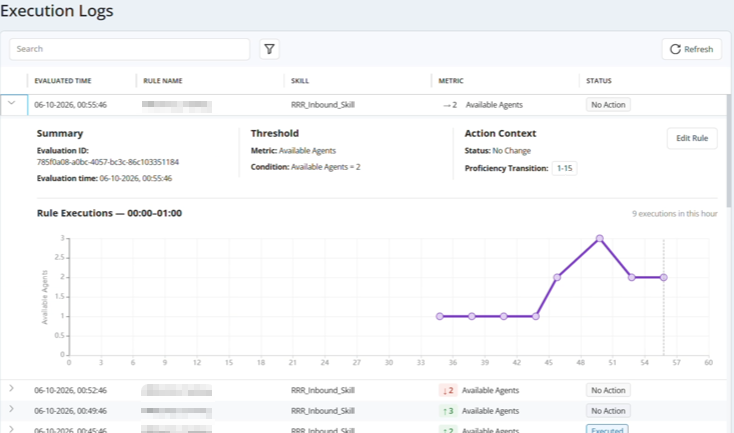
You can now access logs that provide details about the execution of real-time routing rules. The logs provide you data about each time the system executes a rule to route an interaction. This allows you to efficiently review system behavior, validate routing outcomes, and troubleshoot issues. You can see:
- The time the rule executed. When you expand a log, you can see the full date and time of execution.
- The ACD skill that the rule used.
- The metric the rule uses. When you expand a log, you can see the condition set for the metric. You can also see a graph of the metric for each time the rule has executed that day.
- The status of that instance of rule execution. When you spend a log, you can see more details about the status.
You can search and filter the log results by ACD skill, status, and metric to find the entries you want.
| Customer Request |
No |
UI Change |
Yes |
Availability | Preview
On toggle |
Actions
Multi-Currency Support for ROI Calculations in Automated Insights
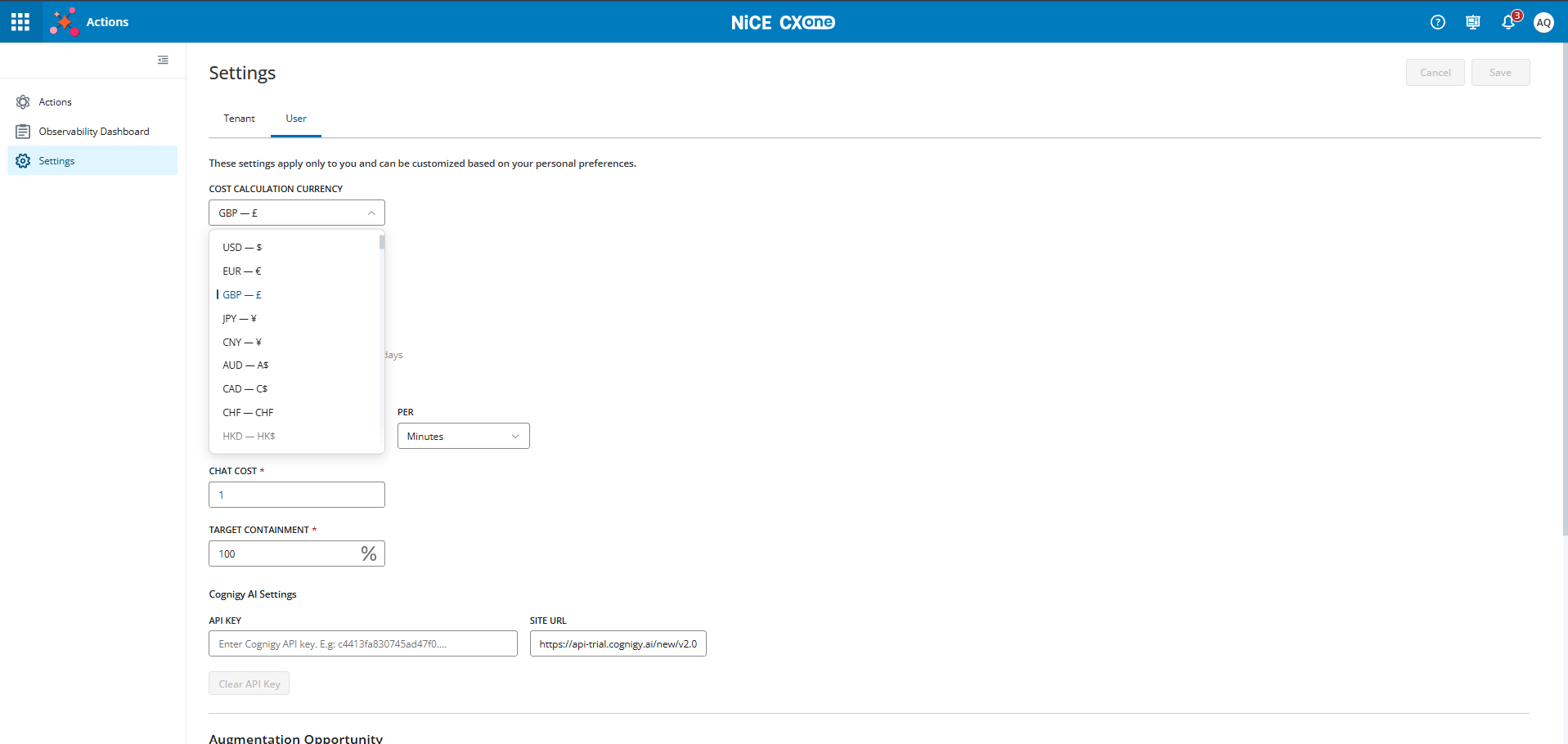
Previously, the Cost Calculation settings that fed your ROI calculations were set to US dollars only. If you entered call or chat costs from outside the US, you could not show your actual currency, and the label always read “USD”.
In this release, you can choose your currency from a new Cost Calculation Currency drop-down on the User tab of the Settings page. This one setting applies to both Automation Opportunity and Augmentation Opportunity. You can:
-
Pick your currency from a list where each option shows the currency code and its symbol, for example USD ($), EUR (€), or GBP (£).
-
See the currency you select on the Settings page, on the Automation Opportunity and Augmentation Opportunity dashboards, and in answers in the Conversational Panel. The Potential ROI card also shows the currency code, for example Potential ROI (GBP).
-
Keep your own choice. This setting applies only to you, so other users in your organization can choose a different currency. If you do not select a currency, Actions uses US dollars ($).
| Customer Request |
No |
UI Change |
Yes |
Availability | GA
On toggle |
One-Click AI Agent Testing with Cognigy AI Simulator
Previously, after Automated Insights helped you spot an Automation Opportunity, you built an AI agent in Actions and published it to AI Agents (Cognigy). To test it, you had to recreate test scenarios by hand in the Cognigy AI Simulator. There was no direct path from the Automated Insights to a test you could run.
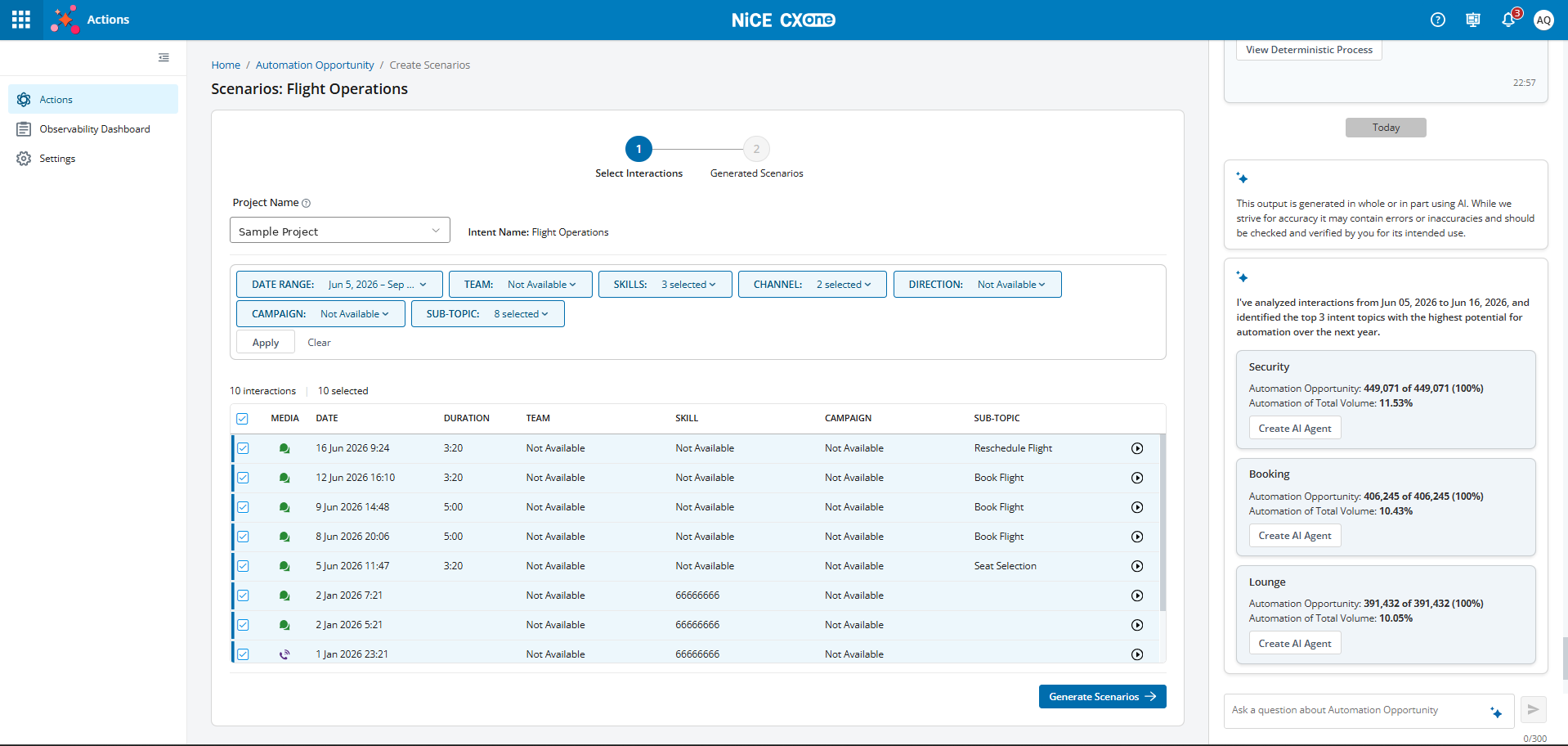
In this release, you can create scenarios for an intent (category or topic) directly in Automated Insights and send them to the Simulator in AI Agents (Cognigy) in a single click. You can:
-
Select Create Scenarios when you hover over an intent in the Automation Potential by Intent Category chart or the Automation Opportunity and KPI chart. You can create scenarios for any intent, even one you have not built an AI agent for yet.
-
Choose interactions using the filters you already use in Automated Insights, such as Date Range, Team, Skill, Channel, Direction, Campaign, and Sub-Topic instead of finding them separately.
-
Let AI create scenarios from the interactions you select, each with a persona, mission, and success criteria. You can review and edit each scenario before you submit it.
-
Click Submit to Simulator to send the scenarios to the project you select in AI Agents (Cognigy), where you run them against your AI agent flows.
Each interaction you use must have a transcript of at least 100 words. To send scenarios, you need a project in AI Agents (Cognigy) that has a large language model (LLM) set up.
| Customer Request |
No |
UI Change |
Yes |
Availability | GA
On toggle |
Best-Performing-Agent Training Data for AI Agent Builder
In this release, Automated Insights uses a data-driven Best-Agent Selection process to find and curate high-quality training transcripts when you create an AI agent, building on the existing best-interaction selection and sampling logic. You can:
-
Get interactions
The full conversation with an agent through a channel. For example, an interaction can be a voice call, email, chat, or social media conversation. ranked by proven agent behaviors, such as empathy and active listening, along with quality indicators that include automatability, sentiment, and having at least three resolution actions. -
Have AI agents trained on 20 to 100 of the best human-assisted interactions for an intent, so they learn from proven agent behaviors and best practices instead of a random mix. Actions uses only interactions that match the filters you applied at the top of the dashboard.
-
Build a reliable AI agent from as few as 20 qualified interactions, down from about 100 previously. This makes it easier to automate lower-volume intents.
-
See guidance in the Conversational Panel when fewer than 20 qualified interactions are available, with a suggestion to change your filters to include more interactions.
This means your AI agents learn from strong human-agent behaviors rather than an unfiltered mix, and you can build and launch an AI agent sooner without waiting to collect large volumes of training data.
| Customer Request |
Yes |
UI Change |
No |
Availability | GA
On toggle |
Actions Compliant with Web Content Accessibility Guidelines (WCAG 2.2 Level AA)
In this release, Actions is compliant with the Web Content Accessibility Guidelines (WCAG) 2.2 at Level AA on the Settings, Automated Insights, Followed Charts, Email, and Knowledge Article pages. This follows fixes to accessibility issues found during an independent accessibility evaluation. If you use a screen reader, a keyboard instead of a mouse, or screen magnification, you can:
-
Hear labels, names, and states on buttons, tooltips, and form fields read out by your screen reader.
-
Reach more controls with the keyboard, with focus that returns to the right place after you close a menu.
-
Hear loading and status messages announced without having to move to them.
-
See clearer page tabs and insight cards, with colors that are easier to see.
WCAG is the standard for accessible web content, published by the World Wide Web Consortium (W3C). Level AA is the level most organizations aim for. These changes do not change how Actions looks or works day to day.
To see which accessibility criteria each Actions page meets, see Accessibility - Actions Pages.
| Customer Request |
No |
UI Change |
No |
Availability | GA
On deploy |
Scalable Skills Selection for Large Enterprise Tenants
Previously, the Skills drop-down in Automation Opportunity and Augmentation Opportunity could slow down or become hard to use for tenants with a very large number of skills, because the control was not built to show tens of thousands of options at once.
In this release, the Team, Skills, and Campaign filters on the Automation Opportunity and Augmentation Opportunity dashboards show up to 500 values at a time and include a search box. You can quickly find the value you need, even when your tenant has far more than 500. You can:
-
Search for a Team, Skills, or Campaign by name. The search looks at all your values, not only the 500 in the list, and you can pick values from more than one search.
-
Select up to 500 values at a time in each of the Team, Skills, and Campaign filters.
-
Remove a filter by clicking the X next to it when you want to see unfiltered data.
| Customer Request |
Yes |
UI Change |
Yes |
Availability | GA
On toggle |
Export Deterministic Flows to Omilia and Amelia Bot Builder
Previously, if you built automation in Actions but still relied on the Omilia or Amelia Bot Builder rather than AI Agents (Cognigy), you could not bring a deterministic flow you built in Actions into your existing Bot Builder.
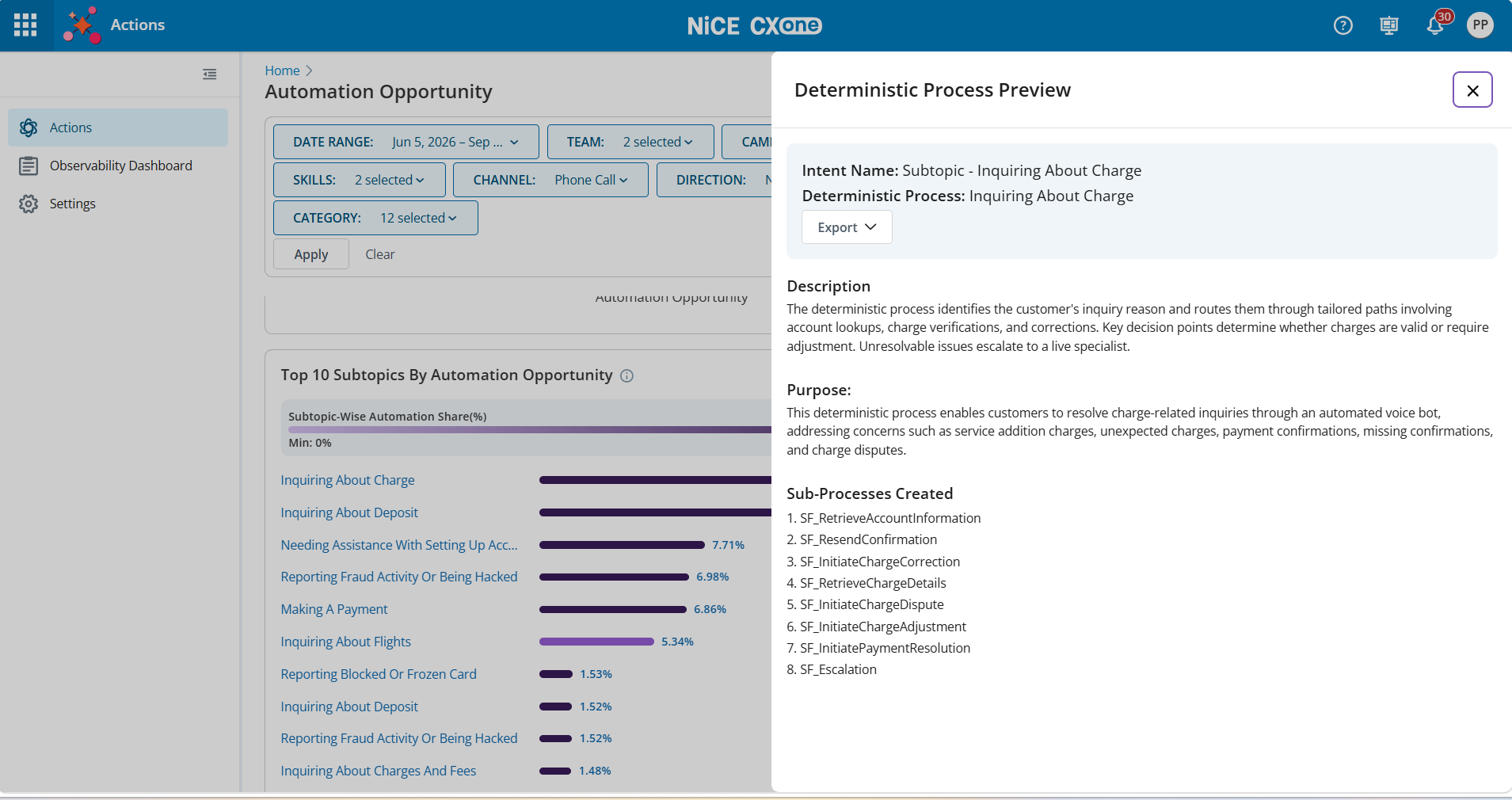
In this release, you can create deterministic flows directly from sub-topic intents in Automated Insights and export them in formats that Omiliaand Amelia can import. This helps you deploy the Automation Opportunity you discover faster. You can:
-
Export a deterministic flow built for any sub-topic intent in Actions, so you do not have to rebuild it from scratch in Omilia or Amelia. Actions does not connect to these bot builders directly. You download the file and import it yourself.
-
Keep using your current Bot Builder while getting a firsthand look at how Actions approaches automation, as a step toward adopting AI Agents (Cognigy).
This feature is available only to select customers who still depend on Omilia or Amelia while they migrate off the legacy XO platform.
| Customer Request |
No |
UI Change |
Yes |
Availability | GA
On toggle |
Desktop Intelligence Data in Actions Data Conversation
In this release, you can ask Actions data conversation about agent desktop activity during a call, using a new Desktop Intelligence domain. You can:
-
Ask plain-language questions about desktop and agent activity data alongside the other domains you already use in Actions, instead of going to a separate module.
-
See suggested questions that match the licenses your tenant has, so you see only what is relevant to you.
| Customer Request |
Yes |
UI Change |
No |
Availability | GA
On toggle |
Multi-Language Support for Automated Insights
In this release, you can view conversations, insights, and related analytical data in Automated Insights in your preferred language, no matter which language the original interaction used. You can:
-
View conversation transcripts, topic hierarchies, insight summaries, widgets, and reports in your selected language across Automated Insights.
-
Get topic analysis in Brazilian Portuguese, Spanish, French, German, Dutch, and Japanese in this phase.
Automated Insights shows its pages in the language set in your web browser. If your browser uses a language that is not supported, pages appear in English. For the full list, see Supported Languages.
| Customer Request |
Yes |
UI Change |
Yes |
Availability | GA
On deploy |
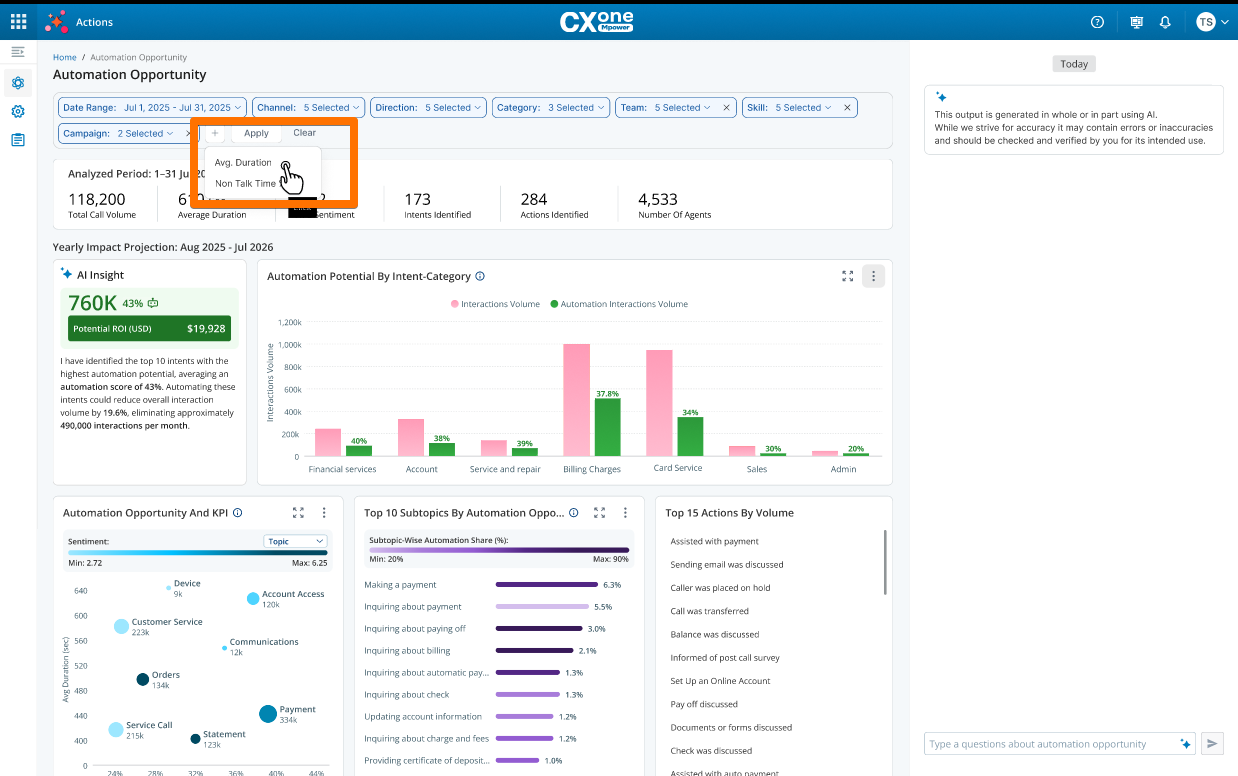
Avg Duration and Non-Talk Time Filters for Automation Opportunity
Previously, you could filter the Automation Opportunity page by criteria such as Date Range, Channel, Direction, Category, Team, Skill, and Campaign.
In this release, you can filter the Automation Opportunity page by two more criteria: Avg. Duration and Non Talk Time %. To add them, click the + icon next to Apply and select a filter. You can:
-
Set a minimum and maximum average duration to narrow the interactions the page analyzes. This lets you focus on calls of a specific length instead of your full interaction volume.
-
Set a minimum and maximum non-talk-time percentage to filter for interactions with more or less silence, meaning periods when no one on the call is talking. This helps you find automation candidates tied to specific conversation patterns, not only topic or duration.
| Customer Request |
No |
UI Change |
Yes |
Availability | GA
On toggle |
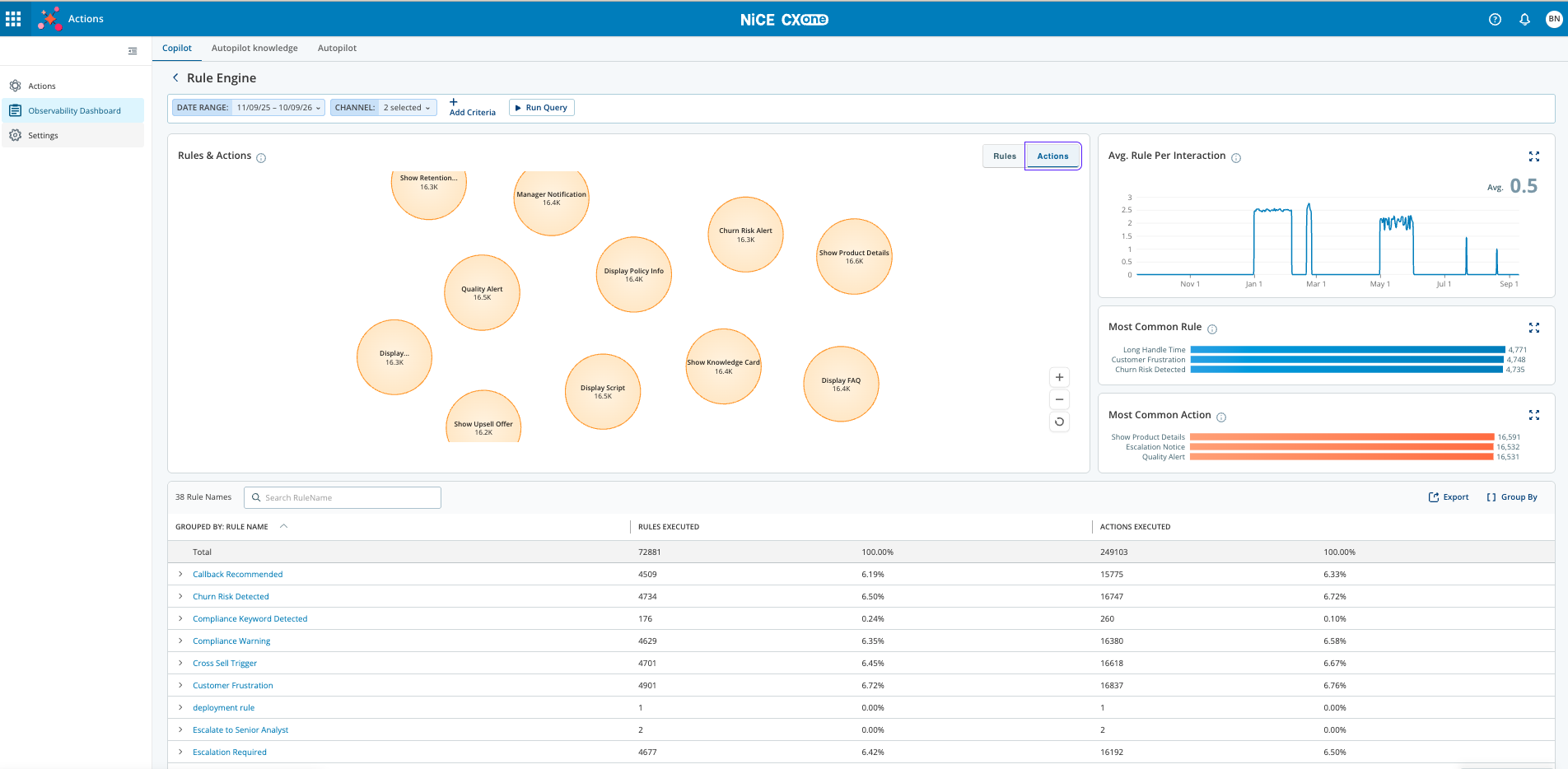
Rule Engine Analytics in the Observability Dashboard
In this release, you can use the Rule Engine view on the Copilot dashboard of the Observability Dashboard to see how the rules you set up for Copilot for Agents work during interactions. Use it to check that your rules work as planned and to find coaching opportunities. You can:
-
See each rule or action as a bubble in the Rules & Actions chart. The bigger the bubble, the more often it fired.
-
Track the average number of rules that fired in each interaction over time, and see the rules and actions that fired most often.
-
Review a table that shows how many times each rule fired and how many actions it produced. You can search, group, and export the table.
-
Open an interaction to see the action and rule that fired, the agent, skill, and team, and when in the interaction the rule fired. You can also play the interaction from there.
Rule Engine shows data after interactions end. It does not show what is happening during a live interaction. To create or change rules, go to AI Studio.
| Customer Request |
Yes |
UI Change |
Yes |
Availability | GA
On deploy |
Expanded Export Fields for Agent Queries in the Observability Dashboard
Previously, when you exported Agent Queries data from the Observability Dashboard, the export did not include Team, Skill, Contact ID, or Master Contact ID. These fields were already available when you exported Generative Responses data.
In this release, Agent Queries exports include these same fields, matching Generative Responses. You can:
-
See team and skill in your Agent Queries export, so you can slice Agent Queries data the same way you slice Generative Responses data.
-
See both a Master Contact ID and a Contact ID on each row. Group by Master Contact ID to view queries per call, or by Contact ID to view queries per call segment. This is useful when a single call has multiple legs, such as IVR, agent, and transfer.
| Customer Request |
Yes |
UI Change |
No |
Availability | GA
On deploy |
Admin
Simplified mTLS Authentication
Starting in release 26.4, NiCE CXone APIs support Mutual TLS (mTLS) authentication to cryptographically verify calling systems using client certificates without disrupting existing integrations. Alongside this, a new Certificates tab in Account Settings allows tenant administrators to upload, manage, and remove PEM-encoded X.509 certificates with automated validation for formats, algorithms, and key sizes, duplicate prevention, expiration tracking badges, and single-action global saving.
| Customer Request |
Yes |
UI Change |
Yes |
Availability | GA
On toggle |
GLA Certificate Validation
Security for Login Authenticator certificates is improved by adding strict validation checks. The system only accepts valid PEM‑encoded X.509 certificates that use strong encryption, such as RSA 2048-bit or higher and SHA‑256 or better. It also checks for issues like expired certificates, invalid formats, or weak encryption. If there are any problems, it shows clear error messages so they can be resolved easily. This update helps prevent security risks and ensures only safe, secure certificates are used.
| Customer Request |
Yes |
UI Change |
Yes |
Availability | GA
On toggle |
Simplified Login for BCP Users
You can maintain seamless operations during outages with a new, self-service environment selection screen. After logging in, you see real-time status cards for both your Production and Multi-Region BCP environments, clearly labeled as Active, Available, or Unavailable. If the Production environment goes down, the system automatically disables it and pre-selects your BCP tenant. You can then simply click Proceed or press Enter to jump straight into your work without any manual guesswork. This update ensures you always know exactly which tenant you enter, keeping your business running smoothly even during critical recovery events.
| Customer Request |
Yes |
UI Change |
Yes |
Availability | GA
On toggle |
Certificate Expiry Alerts in Login Authenticators
Managing SSO/SAML authenticators is more intuitive, with new indicators to prevent sign-in failures caused by expired identity provider certificates. A new Certificate status column in the Login Authenticators list shows clear, color-coded indicators — Expired, Near expiry, and Valid — with a sortable view to help prioritize renewals. Alert banners also appear on the SAML configuration page 30 days before a certificate expires, giving time to rotate it before it affects user access. Uploading a new certificate is also easier, with specific inline messages flagging the wrong file type, an invalid format, an expired certificate, or an unreadable file, along with a hint showing the accepted format.
| Customer Request |
Yes |
UI Change |
Yes |
Availability | GA
On toggle |
Enhanced Security for Authenticator Secrets
To provide stronger protection for sensitive integration keys, NiCE CXone transitions all authenticator credentials such as Microsoft Entra ID client secrets and private keys to a secure write-only model. These secrets are no longer retrievable or viewable in the UI or via APIs after they are saved. New v2 APIs support this enhanced privacy, ensuring that even administrators cannot reveal or access stored credentials. While no action is required for existing configurations, all secret fields are permanently masked to prevent unauthorized exposure and ensure your platform remains secure.
| Customer Request |
Yes |
UI Change |
Yes |
Availability | GA
On toggle |
Division Support for Locations
NiCE CXone extends Divisions to include Locations. This lets administrators link Locations to specific Divisions for better visibility and access control. When creating Locations, you can assign them to Divisions. Existing Locations are automatically placed in the Default Division. For added security, each Location is allowed to move only once from the Default Division to another Division.
| Customer Request |
Yes |
UI Change |
Yes |
Availability | GA
On toggle |
Enhanced Usability for NiCE CXone Divisions
The Division Management page includes improvements that make it easier for administrators to organize and find resources. You can sort your division list by the Parent Division column, providing a clearer view of your division structure.
New filters for Division Type and Billing Code are also available. These filters help you quickly find what you need by enabling faster searches and better grouping of results. These enhancements reduce manual effort and make Division Management easier to navigate.
| Customer Request |
Yes |
UI Change |
Yes |
Availability | GA
On toggle |
Automatic Expiry for Secondary Roles
Administrators can set an expiration date when assigning secondary roles. The system automatically removes the role at midnight on the selected date—no manual cleanup needed. Every removal is recorded in the audit logs, keeping short-term access simple, secure, and compliant.
| Customer Request |
Yes |
UI Change |
Yes |
Availability | GA
On toggle |
Team and Group Lookup APIs
NiCE CXone introduces two new API endpoints that allow developers to retrieve basic team and group details (ID and name) without requiring special permissions. With built-in support for filtering, sorting, and pagination, these endpoints make it easy to populate dropdowns, manage data mapping, and search for specific entities, simplifying integration workflows without relying on permission-gated APIs.
| Customer Request |
Yes |
UI Change |
Yes |
Availability | GA
On toggle |
Simplified, Clearer Change History
The Change History tab is simplified by removing the summary section that displays record creation and last modification details. All existing functionality, including filters, reports, change counts, and the detailed change log, continues to work as before. Entity references also display more user-friendly names instead of internal IDs, making it easier to understand which groups, roles, teams, and other items were changed. These updates ensure that all essential details remain available in a simple, responsive, and easy-to-understand format.
| Customer Request |
Yes |
UI Change |
Yes |
Availability | GA
On toggle |
Non-Billable User Limit Increase
The number of non-billable user accounts allowed per tenant has increased. Previously, NiCE CXone allowed a maximum of 25 non-billable user accounts. From this release, the number of non-billable user accounts is a configurable setting in each tenant. Additionally, the maximum number of non-billable user accounts has increased to 150. The default is 25. This setting must be made by your account representative in Tenant Management.
| Customer Request |
No |
UI Change |
Yes |
Availability | GA
On toggle |
Agent Workspace (Agent)
Improved State Management During Live Monitoring
Agents who also perform supervisor duties can change their availability status in Agent Workspace (Agent) even while a live voice monitoring session is active in another tab.
| Customer Request |
Yes |
UI Change |
No |
Availability | GA
On toggle |
Centralized Management for Panel Open in Browser Settings
Administrators and supervisors can centrally configure and manage specific settings within the Agent Workspace (Agent) Settings app through Desktop Profiles. This update includes the ability to lock settings for consistency across the contact center or allow agents to override them, starting with the Panel Open in Browser options.
| Customer Request |
Yes |
UI Change |
Yes |
Availability | GA
On toggle |
Queue Counter Support for Outbound Voice
Agent Workspace (Agent) includes an Outbound Voice section in the Queue Counter app, providing agents with real-time visibility into outbound queue counts and agent states. This update supports both Personal Connection and Outbound Engagement (SmartReach), ensuring agents can effectively prioritize their work and monitor outbound campaign activity.
| Customer Request |
Yes |
UI Change |
Yes |
Availability | GA
On toggle |
Editable Customer Names in Agent Workspace (Agent)
Agents can edit customer names directly within the DX-based Customer Card app in Agent Workspace (Agent). This feature allows agents to replace generic or placeholder names with accurate identifiers, making it easier to distinguish between multiple active digital interactions The full conversation with an agent through a channel. For example, an interaction can be a voice call, email, chat, or social media conversation..
| Customer Request |
Yes |
UI Change |
Yes |
Availability | GA
On toggle |
Simultaneous Primary and Secondary Ringing
Agent Workspace (Agent) supports simultaneous ringing across primary and secondary audio devices for voice calls. This update ensures that the primary ringer continues to sound even after the secondary ringer begins, helping agents avoid missed calls.
| Customer Request |
Yes |
UI Change |
No |
Availability | GA
On deploy |
Read-Only Forwarded Email Content
Previously, editing of forwarded email content was possible. However, the edits were not actually saved after sending a message. To ensure consistency and prevent unintended message delivery, Agent Workspace (Agent) disabled editing of forwarded email content within the agent response editor.
| Customer Request |
Yes |
UI Change |
Yes |
Availability | GA
On toggle |
Reschedule Personal Connection Contacts for a Skill or Agent
Agents can choose whether to reschedule a Personal Connection contact The person interacting with an agent, IVR, or bot in your contact center. for themselves or make it available to the next available agent in the skill Used to automate delivery of interactions based on agent skills, abilities, and knowledge., providing greater flexibility in contact management.
| Customer Request |
Yes |
UI Change |
Yes |
Availability | GA
On deploy |
Multi-Party Real-Time Transcription for Voice
Agent Workspace (Agent) supports real-time transcription for voice calls with three or more participants, including conference calls. This update ensures that agents can view a continuous transcript regardless of the number of participants on the call.
| Customer Request |
Yes |
UI Change |
Yes |
Availability | GA
On toggle |
Native In-Application Diagnostic Log Collection
Agents can download web browser diagnostic logs directly from the Agent Workspace (Agent) Settings app to simplify the troubleshooting process. This new feature provides a one-click method to capture essential session data, such as network traffic and console logs, without requiring complex manual steps.
| Customer Request |
Yes |
UI Change |
Yes |
Availability | GA
On deploy |
Persistent App State in Agent Workspace (Agent)
Agent Workspace (Agent) maintains the state of specific apps in the App Space, such as Customer Card, Directory, and Screen Pop, when you navigate between different screens or interactions The full conversation with an agent through a channel. For example, an interaction can be a voice call, email, chat, or social media conversation.. This update eliminates unnecessary page refreshes, ensuring that you do not lose context or data when switching tasks.
| Customer Request |
Yes |
UI Change |
Yes |
Availability | GA
On toggle |
Enhanced Skill Filtering for Digital Interaction Search
Agent Workspace (Agent) introduced an optimized skill Used to automate delivery of interactions based on agent skills, abilities, and knowledge. filter for digital Any channel, contact, or skill associated with Digital Experience (DX). interaction searches that supports large-scale environments with up to 20,000 skills. This update features server-side searching and infinite scrolling to ensure a fast, responsive experience without UI delays when managing extensive skill lists.
| Customer Request |
Yes |
UI Change |
Yes |
Availability | GA
On deploy |
Scroll Control and Context Preservation for Internal Chat
Internal Chat features enhanced scroll control to prevent automatic scrolling when new messages arrive. This update allows users to review historical messages without losing their place, while a new message indicator provides a quick way to return to the latest conversation.
| Customer Request |
|
UI Change |
|
Availability | GA
On toggle |

Emoji Support for Internal Chat
Internal Chat supports emojis, allowing you to express reactions and communicate more effectively with colleagues. You can insert emojis directly into your messages using an integrated emoji picker or standard keyboard input to add emotional context and personalization to your interactions.
| Customer Request |
|
UI Change |
|
Availability | GA
On deploy |
Agent Workspace (Embedded) (Agent Embedded)
Improved State Management During Live Monitoring
Agents who also perform supervisor duties can change their availability status in Agent Workspace (Embedded) (Agent Embedded) even while a live voice monitoring session is active in another tab.
| Customer Request |
Yes |
UI Change |
No |
Availability | GA
On toggle |
Centralized Management for Panel Open in Browser Settings
Administrators and supervisors can centrally configure and manage specific settings within the Agent Workspace (Embedded) (Agent Embedded) Settings app through Desktop Profiles. This update includes the ability to lock settings for consistency across the contact center or allow agents to override them, starting with the Panel Open in Browser options.
| Customer Request |
Yes |
UI Change |
Yes |
Availability | GA
On toggle |
Queue Counter Support for Outbound Voice
Agent Workspace (Embedded) (Agent Embedded) includes an Outbound Voice section in the Queue Counter app, providing agents with real-time visibility into outbound queue counts and agent states. This update supports both Personal Connection and Outbound Engagement (SmartReach), ensuring agents can effectively prioritize their work and monitor outbound campaign activity.
| Customer Request |
Yes |
UI Change |
Yes |
Availability | GA
On toggle |
Editable Customer Names in Agent Workspace (Embedded) (Agent Embedded)
Agents can edit customer names directly within the DX-based Customer Card app in Agent Workspace (Embedded) (Agent Embedded). This feature allows agents to replace generic or placeholder names with accurate identifiers, making it easier to distinguish between multiple active digital interactions The full conversation with an agent through a channel. For example, an interaction can be a voice call, email, chat, or social media conversation..
| Customer Request |
Yes |
UI Change |
Yes |
Availability | GA
On toggle |
Simultaneous Primary and Secondary Ringing
Agent Workspace (Embedded) (Agent Embedded) supports simultaneous ringing across primary and secondary audio devices for voice calls. This update ensures that the primary ringer continues to sound even after the secondary ringer begins, helping agents avoid missed calls.
| Customer Request |
Yes |
UI Change |
No |
Availability | GA
On deploy |
Read-Only Forwarded Email Content
Previously, editing of forwarded email content was possible. However, the edits were not actually saved after sending a message. To ensure consistency and prevent unintended message delivery, Agent Workspace (Embedded) (Agent Embedded) disabled editing of forwarded email content within the agent response editor.
| Customer Request |
Yes |
UI Change |
Yes |
Availability | GA
On toggle |
Reschedule Personal Connection Contacts for a Skill or Agent
Agents can choose whether to reschedule a Personal Connection contact The person interacting with an agent, IVR, or bot in your contact center. for themselves or make it available to the next available agent in the skill Used to automate delivery of interactions based on agent skills, abilities, and knowledge., providing greater flexibility in contact management.
| Customer Request |
Yes |
UI Change |
Yes |
Availability | GA
On deploy |
Multi-Party Real-Time Transcription for Voice
Agent Workspace (Embedded) (Agent Embedded) supports real-time transcription for voice calls with three or more participants, including conference calls. This update ensures that agents can view a continuous transcript regardless of the number of participants on the call.
| Customer Request |
Yes |
UI Change |
Yes |
Availability | GA
On toggle |
Native In-Application Diagnostic Log Collection
Agents can download web browser diagnostic logs directly from the Agent Workspace (Embedded) (Agent Embedded) Settings app to simplify the troubleshooting process. This new feature provides a one-click method to capture essential session data, such as network traffic and console logs, without requiring complex manual steps.
| Customer Request |
Yes |
UI Change |
Yes |
Availability | GA
On deploy |
Persistent App State in Agent Workspace (Embedded) (Agent Embedded)
Agent Workspace (Embedded) (Agent Embedded) maintains the state of specific apps in the App Space, such as Customer Card, Directory, and Screen Pop, when you navigate between different screens or interactions The full conversation with an agent through a channel. For example, an interaction can be a voice call, email, chat, or social media conversation.. This update eliminates unnecessary page refreshes, ensuring that you do not lose context or data when switching tasks.
| Customer Request |
Yes |
UI Change |
Yes |
Availability | GA
On toggle |
Enhanced Skill Filtering for Digital Interaction Search
Agent Workspace (Embedded) (Agent Embedded) introduced an optimized skill Used to automate delivery of interactions based on agent skills, abilities, and knowledge. filter for digital Any channel, contact, or skill associated with Digital Experience (DX). interaction searches that supports large-scale environments with up to 20,000 skills. This update features server-side searching and infinite scrolling to ensure a fast, responsive experience without UI delays when managing extensive skill lists.
| Customer Request |
Yes |
UI Change |
Yes |
Availability | GA
On deploy |
Pre-Acceptance Customer Insights for Agent Workspace (Embedded) (Agent Embedded)
Agent Workspace (Embedded) (Agent Embedded) CRM agents can view customer details in the Customer Card as soon as an interaction is delivered, even before they manually accept the contact. This update allows agents to gain immediate context and prepare for the interaction, improving efficiency and response quality.
| Customer Request |
|
UI Change |
|
Availability | GA
On deploy |
Screen Recording Extension-Based Fallback for Agent Workspace (Embedded) (Agent Embedded)
Agent Workspace (Embedded) (Agent Embedded) supports a dual-communication path for screen recording that utilizes a browser extension to bypass recent Chrome local network restrictions. This update ensures reliable screen recording by automatically using the extension as the primary channel while maintaining a seamless fallback to the existing connection method if the extension is unavailable.
| Customer Request |
|
UI Change |
|
Availability | GA
On deploy |
Graceful Handling of Salesforce Lead Conversions
Agent Embedded for Salesforce detects when a Lead is converted into an Account, Contact, or Opportunity during an active interaction. This enhancement ensures that interaction data is accurately saved to the new record, or that agents are prompted to select the correct entity, preventing data loss from invalid Lead IDs.
| Customer Request |
|
UI Change |
|
Availability | GA
On deploy |
Agent Workspace for Microsoft Teams (Agent for Microsoft Teams)
Improved State Management During Live Monitoring
Agents who also perform supervisor duties can change their availability status in Agent Workspace for Microsoft Teams (Agent for Microsoft Teams) even while a live voice monitoring session is active in another tab.
| Customer Request |
Yes |
UI Change |
No |
Availability | GA
On toggle |
Centralized Management for Panel Open in Browser Settings
Administrators and supervisors can centrally configure and manage specific settings within the Agent Workspace for Microsoft Teams (Agent for Microsoft Teams) Settings app through Desktop Profiles. This update includes the ability to lock settings for consistency across the contact center or allow agents to override them, starting with the Panel Open in Browser options.
| Customer Request |
Yes |
UI Change |
Yes |
Availability | GA
On toggle |
Queue Counter Support for Outbound Voice
Agent Workspace for Microsoft Teams (Agent for Microsoft Teams) includes an Outbound Voice section in the Queue Counter app, providing agents with real-time visibility into outbound queue counts and agent states. This update supports both Personal Connection and Outbound Engagement (SmartReach), ensuring agents can effectively prioritize their work and monitor outbound campaign activity.
| Customer Request |
Yes |
UI Change |
Yes |
Availability | GA
On toggle |
Editable Customer Names in Agent Workspace for Microsoft Teams (Agent for Microsoft Teams)
Agents can edit customer names directly within the DX-based Customer Card app in Agent Workspace for Microsoft Teams (Agent for Microsoft Teams). This feature allows agents to replace generic or placeholder names with accurate identifiers, making it easier to distinguish between multiple active digital interactions The full conversation with an agent through a channel. For example, an interaction can be a voice call, email, chat, or social media conversation..
| Customer Request |
Yes |
UI Change |
Yes |
Availability | GA
On toggle |
Simultaneous Primary and Secondary Ringing
Agent Workspace for Microsoft Teams (Agent for Microsoft Teams) supports simultaneous ringing across primary and secondary audio devices for voice calls. This update ensures that the primary ringer continues to sound even after the secondary ringer begins, helping agents avoid missed calls.
| Customer Request |
Yes |
UI Change |
No |
Availability | GA
On deploy |
Read-Only Forwarded Email Content
Previously, editing of forwarded email content was possible. However, the edits were not actually saved after sending a message. To ensure consistency and prevent unintended message delivery, Agent Workspace for Microsoft Teams (Agent for Microsoft Teams) disabled editing of forwarded email content within the agent response editor.
| Customer Request |
Yes |
UI Change |
Yes |
Availability | GA
On toggle |
Reschedule Personal Connection Contacts for a Skill or Agent
Agents can choose whether to reschedule a Personal Connection contact The person interacting with an agent, IVR, or bot in your contact center. for themselves or make it available to the next available agent in the skill Used to automate delivery of interactions based on agent skills, abilities, and knowledge., providing greater flexibility in contact management.
| Customer Request |
Yes |
UI Change |
Yes |
Availability | GA
On deploy |
Multi-Party Real-Time Transcription for Voice
Agent Workspace for Microsoft Teams (Agent for Microsoft Teams) supports real-time transcription for voice calls with three or more participants, including conference calls. This update ensures that agents can view a continuous transcript regardless of the number of participants on the call.
| Customer Request |
Yes |
UI Change |
Yes |
Availability | GA
On toggle |
Native In-Application Diagnostic Log Collection
Agents can download web browser diagnostic logs directly from the Agent Workspace for Microsoft Teams (Agent for Microsoft Teams) Settings app to simplify the troubleshooting process. This new feature provides a one-click method to capture essential session data, such as network traffic and console logs, without requiring complex manual steps.
| Customer Request |
Yes |
UI Change |
Yes |
Availability | GA
On deploy |
Persistent App State in Agent Workspace for Microsoft Teams (Agent for Microsoft Teams)
Agent Workspace for Microsoft Teams (Agent for Microsoft Teams) maintains the state of specific apps in the App Space, such as Customer Card, Directory, and Screen Pop, when you navigate between different screens or interactions The full conversation with an agent through a channel. For example, an interaction can be a voice call, email, chat, or social media conversation.. This update eliminates unnecessary page refreshes, ensuring that you do not lose context or data when switching tasks.
| Customer Request |
Yes |
UI Change |
Yes |
Availability | GA
On toggle |
Enhanced Skill Filtering for Digital Interaction Search
Agent Workspace for Microsoft Teams (Agent for Microsoft Teams) introduced an optimized skill Used to automate delivery of interactions based on agent skills, abilities, and knowledge. filter for digital Any channel, contact, or skill associated with Digital Experience (DX). interaction searches that supports large-scale environments with up to 20,000 skills. This update features server-side searching and infinite scrolling to ensure a fast, responsive experience without UI delays when managing extensive skill lists.
| Customer Request |
Yes |
UI Change |
Yes |
Availability | GA
On deploy |
Agent Workspace for Salesforce Voice
These features will be available later in the release cycle.
NiCE Digital Email Channel Support
NiCE CXone supports digital email interactions directly within the Salesforce Enhanced Omni-Channel widget alongside voice calls. Powered by the NiCE CXone routing engine, incoming email contacts The person interacting with an agent, IVR, or bot in your contact center. are prioritized and delivered in near real time, allowing agents to accept, view, and manage email interactions from a single, unified interface without context switching. This streamlined experience helps improve agent productivity while delivering a more consistent customer experience across voice and email channels.
| Customer Request |
No |
UI Change |
Yes |
Availability | GA
On toggle |
Unified Agent for Salesforce Voice Support in Salesforce GovCloud
The Unified Agent for Salesforce Voice supports the Salesforce GovCloud environment. This allows organizations operating in GovCloud to deploy the Unified Agent seamlessly without requiring additional configurations, ensuring consistent performance, security, and data residency compliance. Agents have full access to end-to-end voice and digital Any channel, contact, or skill associated with Digital Experience (DX).channel Various voice and digital communication mediums that facilitate customer interactions in a contact center. routing for both NICE and Salesforce, standard call controls, bi-directional presence synchronization, agent status mapping, and advanced capabilities including Copilot, Real-Time Transcription, and AutoSummary.
| Customer Request |
Yes |
UI Change |
Yes |
Availability | GA
On toggle |
FedRAMP support for Unified Agent for Salesforce Voice
Agent Workspace for Salesforce Voice supports FedRAMP-compliant environments. This update allows agents in government and regulated organizations to access digital channels and companion applications securely in Agent Workspace for Salesforce Voice while maintaining full compliance with FedRAMP security standards. No customer action is required.
| Customer Request |
No |
UI Change |
No |
Availability | GA
On toggle |
NiCE CXone Copilot for Agents in Agent Workspace for Salesforce Voice
NiCE CXone Copilot for Agents has been integrated into the Unified Agent for Salesforce Voice companion application, delivering real-time, AI-driven assistance for voice and digital interactions directly within Salesforce. Agents can now view live interaction and customer journey summaries, monitor real-time customer sentiment, receive contextual knowledge base recommendations, and automatically generate and sync interaction summaries directly to Salesforce CRM Third-party systems that manage such things as contacts, sales information, support details, and case histories. records to reduce handle times and streamline wrap-up workflows.
| Customer Request |
No |
UI Change | Yes
|
Availability | GA
On toggle |
NiCE ACD Work Item Routing in Agent Workspace for Salesforce Voice
NiCE CXone supports routing NiCE ACD work items Customizable method of delivering contacts to an agent via Studio scripts. directly through the Salesforce Omni-Channel widget. This enables agents using Unified Agent for Salesforce Voice to seamlessly receive and manage NiCE work item channels alongside voice interactions within their Salesforce workspace.
| Customer Request | Yes | UI Change |
No |
Availability | GA
On toggle |
Agent Workspace (Browser Extension) (Agent Integrated)
Improved State Management During Live Monitoring
Agents who also perform supervisor duties can change their availability status in Agent Workspace (Browser Extension) (Agent Integrated) even while a live voice monitoring session is active in another tab.
| Customer Request |
Yes |
UI Change |
No |
Availability | GA
On toggle |
Centralized Management for Panel Open in Browser Settings
Administrators and supervisors can centrally configure and manage specific settings within the Agent Workspace (Browser Extension) (Agent Integrated) Settings app through Desktop Profiles. This update includes the ability to lock settings for consistency across the contact center or allow agents to override them, starting with the Panel Open in Browser options.
| Customer Request |
Yes |
UI Change |
Yes |
Availability | GA
On toggle |
Queue Counter Support for Outbound Voice
Agent Workspace (Browser Extension) (Agent Integrated) includes an Outbound Voice section in the Queue Counter app, providing agents with real-time visibility into outbound queue counts and agent states. This update supports both Personal Connection and Outbound Engagement (SmartReach), ensuring agents can effectively prioritize their work and monitor outbound campaign activity.
| Customer Request |
Yes |
UI Change |
Yes |
Availability | GA
On toggle |
Editable Customer Names in Agent Workspace (Browser Extension) (Agent Integrated)
Agents can edit customer names directly within the DX-based Customer Card app in Agent Workspace (Browser Extension) (Agent Integrated). This feature allows agents to replace generic or placeholder names with accurate identifiers, making it easier to distinguish between multiple active digital interactions The full conversation with an agent through a channel. For example, an interaction can be a voice call, email, chat, or social media conversation..
| Customer Request |
Yes |
UI Change |
Yes |
Availability | GA
On toggle |
Simultaneous Primary and Secondary Ringing
Agent Workspace (Browser Extension) (Agent Integrated) supports simultaneous ringing across primary and secondary audio devices for voice calls. This update ensures that the primary ringer continues to sound even after the secondary ringer begins, helping agents avoid missed calls.
| Customer Request |
Yes |
UI Change |
No |
Availability | GA
On deploy |
Read-Only Forwarded Email Content
Previously, editing of forwarded email content was possible. However, the edits were not actually saved after sending a message. To ensure consistency and prevent unintended message delivery, Agent Workspace (Browser Extension) (Agent Integrated) disabled editing of forwarded email content within the agent response editor.
| Customer Request |
Yes |
UI Change |
Yes |
Availability | GA
On toggle |
Reschedule Personal Connection Contacts for a Skill or Agent
Agents can choose whether to reschedule a Personal Connection contact The person interacting with an agent, IVR, or bot in your contact center. for themselves or make it available to the next available agent in the skill Used to automate delivery of interactions based on agent skills, abilities, and knowledge., providing greater flexibility in contact management.
| Customer Request |
Yes |
UI Change |
Yes |
Availability | GA
On deploy |
Multi-Party Real-Time Transcription for Voice
Agent Workspace (Browser Extension) (Agent Integrated) supports real-time transcription for voice calls with three or more participants, including conference calls. This update ensures that agents can view a continuous transcript regardless of the number of participants on the call.
| Customer Request |
Yes |
UI Change |
Yes |
Availability | GA
On toggle |
Native In-Application Diagnostic Log Collection
Agents can download web browser diagnostic logs directly from the Agent Workspace (Browser Extension) (Agent Integrated) Settings app to simplify the troubleshooting process. This new feature provides a one-click method to capture essential session data, such as network traffic and console logs, without requiring complex manual steps.
| Customer Request |
Yes |
UI Change |
Yes |
Availability | GA
On deploy |
Persistent App State in Agent Workspace (Browser Extension) (Agent Integrated)
Agent Workspace (Browser Extension) (Agent Integrated) maintains the state of specific apps in the App Space, such as Customer Card, Directory, and Screen Pop, when you navigate between different screens or interactions The full conversation with an agent through a channel. For example, an interaction can be a voice call, email, chat, or social media conversation.. This update eliminates unnecessary page refreshes, ensuring that you do not lose context or data when switching tasks.
| Customer Request |
Yes |
UI Change |
Yes |
Availability | GA
On toggle |
Enhanced Skill Filtering for Digital Interaction Search
Agent Workspace (Browser Extension) (Agent Integrated) introduced an optimized skill Used to automate delivery of interactions based on agent skills, abilities, and knowledge. filter for digital Any channel, contact, or skill associated with Digital Experience (DX). interaction searches that supports large-scale environments with up to 20,000 skills. This update features server-side searching and infinite scrolling to ensure a fast, responsive experience without UI delays when managing extensive skill lists.
| Customer Request |
Yes |
UI Change |
Yes |
Availability | GA
On deploy |
Pre-Acceptance Customer Insights for Agent Workspace (Browser Extension) (Agent Integrated)
Agent Workspace (Browser Extension) (Agent Integrated) CRM agents will soon be able to view customer details in the Customer Card as soon as an interaction is delivered, even before they manually accept the contact. This update will allow agents to gain immediate context and prepare for the interaction, improving efficiency and response quality.
| Customer Request |
|
UI Change |
|
Availability | GA
On deploy |
Screen Recording Extension-Based Fallback for Agent Workspace (Browser Extension) (Agent Integrated)
Agent Workspace (Browser Extension) (Agent Integrated) will soon support a dual-communication path for screen recording that utilizes a browser extension to bypass recent Chrome local network restrictions. This update will ensure reliable screen recording by automatically using the extension as the primary channel while maintaining a seamless fallback to the existing connection method if the extension is unavailable.
| Customer Request |
|
UI Change |
|
Availability | GA
On deploy |
Graceful Handling of Salesforce Lead Conversions
Agent Embedded for Salesforce detects when a Lead is converted into an Account, Contact, or Opportunity during an active interaction. This enhancement ensures that interaction data is accurately saved to the new record, or that agents are prompted to select the correct entity, preventing data loss from invalid Lead IDs.
| Customer Request |
|
UI Change |
|
Availability | GA
On deploy |
Agent Workspace Advanced (Enhanced Customer Card)
Enhanced Scalability for Agent Workspace Advanced (Enhanced Customer Card)
Agent Workspace Advanced (Enhanced Customer Card) now supports up to 100,000 named agents, ensuring seamless performance across all agent selection interfaces such as filters and assignment drop-downs. This update allows large-scale organizations to manage extensive agent rosters more efficiently within the platform.
| Customer Request |
Yes |
UI Change |
No |
Availability | GA
On deploy |
Enhanced Platform Scalability
The Scripting feature allows you to select up to 20,000 skills to better serve large-scale enterprise operations.
| Customer Request |
No |
UI Change |
Yes |
Availability | GA
On deploy |
Assigning Desktop Types
In Designer, when creating a new Designer desktop, you can define whether this layout should be used for a CX agent or Agent Workspace 2.0 and indicate whether this layout is for Agent Workspace Advanced (Enhanced Customer Card)
| Customer Request |
No |
UI Change |
Yes |
Availability | GA
On deploy |
Customizable Agent Workspace Layouts by Team
You can assign specific Agent Workspace Advanced layouts to different agent teams. This update ensures that agents automatically see the specific tools, components, and workflows relevant to their unique roles and responsibilities upon signing in.
| Customer Request |
No |
UI Change |
Yes |
Availability | GA
On deploy |
Customer Name Display on Active Interaction Cards
The Agent Workspace automatically displays the customer's name on active interaction cards whenever an exact match is found. This enhancement ensures agents can quickly identify callers and provide a more personalized experience from the moment an interaction begins.
| Customer Request |
No |
UI Change |
Yes |
Availability | GA
On deploy |
Accessibility Support for WCAG 2.2 (Phase 2)
The Agent experience and administrative portions of Agent Workspace Advanced (Enhanced Customer Card) are updated to meet WCAG 2.2 AA accessibility standards. These enhancements provides a more inclusive experience for users relying on assistive technologies.
| Customer Request |
Yes |
UI Change |
Yes |
Availability | GA
On deploy |
NiCE CXone Contact ID Support for Interactions
Agent Workspace Advanced (Enhanced Customer Card) supports the persistent storage and retrieval of the NiCE CXone contact ID for interactions consumed through NiCE CXone streams. This update enables NiCE CXone applications to consistently identify and correlate customer interactions across the platform.
| Customer Request |
No |
UI Change |
No |
Availability | GA
On deploy |
Enhanced Digital Interaction History
To ensure a more complete interaction history, CX Streams enhanced how digital contact The person interacting with an agent, IVR, or bot in your contact center. data is captured and stored. For integrated Agent Workspace Advanced (Enhanced Customer Card), Agent Workspace Premium (Desk), and Outbound Engagement (SmartReach) environments, the disposition notes and disposition outcomes are stored in the interaction history for digital Any channel, contact, or skill associated with Digital Experience (DX). interactions.
| Customer Request |
No |
UI Change |
No |
Availability | GA
On deploy |
Agent Workspace Premium (Desk)
Configurable Interaction Auto-Focus for Agent Workspace Premium (Desk) Scripter
Administrators can choose whether the Agent Scripting or Canvas component automatically receives focus when a new voice interaction The full conversation with an agent through a channel. For example, an interaction can be a voice call, email, chat, or social media conversation. arrives. This update allows organizations to automatically display the Agent Workspace Premium (Desk) Scripter component when a new call is received.
| Customer Request |
No |
UI Change |
No |
Availability | GA
On deploy |
Ticketing AI Assistant: Related and Similar Tickets
Agents can benefit from an AI-powered assistant that automatically identifies and surfaces similar historical tickets during the creation and handling process. This provides real-time visibility into past resolutions and relevant context, helping teams reduce duplicate effort and improve resolution consistency.
| Customer Request |
No |
UI Change |
No |
Availability | GA
On deploy |
Decoupled Ticketing Workflow Emails
A new native ticketing email notification framework allows automated workflow emails to be sent independently of the broader Outbound Engagement (SmartReach) email infrastructure. This enhancement simplifies the setup process by enabling ticket creation and update notifications through a platform-managed delivery service.
| Customer Request |
No |
UI Change |
No |
Availability | GA
On deploy |
Agent Scripter: CX Interaction Attribution
Agent Scripter reporting includes unique CX identifiers, such as contact The person interacting with an agent, IVR, or bot in your contact center. and interaction The full conversation with an agent through a channel. For example, an interaction can be a voice call, email, chat, or social media conversation. IDs, to help you correlate script activity with specific voice or digital Any channel, contact, or skill associated with Digital Experience (DX). interactions. This enhancement provides better visibility into how scripts are used during customer engagements within Agent Workspace Premium (Desk).
| Customer Request |
No |
UI Change |
Yes |
Availability | GA
On deploy |
Enhanced Platform Scalability
The Scripting feature now allows you to select up to 20,000 skills to better serve large-scale enterprise operations.
| Customer Request |
No |
UI Change |
Yes |
Availability | GA
On deploy |
Customizable Agent Workspace Layouts by Team
Administrators can now assign specific Agent Workspace Premium (Desk) layouts to different agent teams. This update ensures that agents automatically see the specific tools, components, and workflows relevant to their unique roles and responsibilities upon signing in.
| Customer Request |
No |
UI Change |
Yes |
Availability | GA
On deploy |
Customer Name Display on Active Interaction Cards
The Agent Workspace automatically displays the customer's name on active interaction cards whenever an exact match is found. This enhancement ensures agents can quickly identify callers and provide a more personalized experience from the moment an interaction begins.
| Customer Request |
No |
UI Change |
Yes |
Availability | GA
On deploy |
Accessibility Support for WCAG 2.2 (Phase 2)
The Agent experience and administrative portions of Agent Workspace Premium (Desk) are updated to meet WCAG 2.2 AA accessibility standards. These enhancements provide a more inclusive experience for users relying on assistive technologies.
| Customer Request |
Yes |
UI Change |
Yes |
Availability | GA
On deploy |
NiCE CXone Contact ID Support for Interactions
Agent Workspace Premium (Desk) supports the persistent storage and retrieval of the NiCE CXone contact ID for interactions consumed through NiCE CXone streams. This update enables NiCE CXone applications to consistently identify and correlate customer interactions across the platform.
| Customer Request |
No |
UI Change |
No |
Availability | GA
On deploy |
Enhanced Digital Interaction History
To ensure a more complete interaction history, CX Streams enhanced how digital contact The person interacting with an agent, IVR, or bot in your contact center. data is captured and stored. For integrated Agent Workspace Advanced (Enhanced Customer Card), Agent Workspace Premium (Desk), and Outbound Engagement (SmartReach) environments, the disposition notes and disposition outcomes will be stored in the interaction history for digital Any channel, contact, or skill associated with Digital Experience (DX). interactions.
| Customer Request |
No |
UI Change |
No |
Availability | GA
On deploy |
Analytics Services
Analytics Policies & Pipeline Enhancements
The Analytics Policies and pipeline updates improve efficiency, accuracy, usability, and security.
Key enhancements include:
-
Conditional Transcription: Post-call transcription runs only when at least one billable application scope, such as Interaction Analytics (CXone) or Quality Management, is selected in an Analytics Policy. This helps prevent unnecessary processing costs. Policies without a selected scope continue to apply redaction rules to existing real-time transcripts.
-
Billing Impact Warnings: The Analytics Policy editor displays a warning when you deselect the Can Be Analyzed or Can Be Evaluated filters, helping you understand potential changes to billable user counts before saving your changes.
-
Language Restrictions: To ensure feature compatibility, the system automatically disables and deselects the Topic AI checkbox whenever Welsh is selected as the policy language.
-
Enhanced Data Security: The Segments ID API honors Role-Based Access Control (RBAC), ensuring that users see only segment metadata associated with their assigned teams, skills
Used to automate delivery of interactions based on agent skills, abilities, and knowledge., or divisions Separate data securely between lines of business. Data can only be accessed from within the division it's part of..
| Customer Request |
No |
UI Change |
Yes |
Availability | GA
On toggle |
Improved Accuracy and Readability for Interaction Redaction
The Redaction engine now delivers higher entity-based redaction accuracy and a more intuitive viewing experience.
Key features include:
-
Entity-based redaction supports Spanish and Brazilian Portuguese.
-
Entity-based redaction replaces generic [MASKED] tags with specific labels, such as [ADDRESS] or [NAME], providing better context within transcripts.
-
When consecutive words are redacted for the same entity type (for example, a full name or a list of names), the system collapses them into a single label, such as [NAME], to reduce visual clutter.
| Customer Request |
No |
UI Change |
Yes |
Availability | GA
On toggle |
Enhanced Example Relevance Sorting in Topic AI
The Topic AI information pane now features an improved display for subtopic examples. This update automatically sorts examples from the most accurate to the least accurate. This change allows users to immediately identify the most important data associated with an intent The meaning or purpose behind what a contact says/types; what the contact wants to communicate or accomplish., facilitating faster decisions on whether to rename, remove, or merge subtopics. By prioritizing high-impact examples at the top of the list, the validation process has become more intuitive and efficient. This improvement is available for all models that are enriched starting in version 26.4.
| Customer Request |
No |
UI Change |
Yes |
Availability | GA
On toggle |
Topic AI Application Localization
Previously, the Topic AI was available exclusively in English. In this release it supports full localization within the NiCE CXone ecosystem. This update ensures that the application aligns with the NiCE CXone multi-language framework, automatically detecting your browser settings to deliver a seamless, native-language experience.
This feature is available via a toggle in the NiCE CXone environments.
| Customer Request | No | UI Change | Yes | Availability | GA
On toggle |
Multilingual Support for Blended Whitespace and Non-Whitespace Languages
Topic AI now supports mixed-language environments, allowing models to be enriched with transcripts containing both whitespace (English) and non-whitespace (Japanese) languages. By using a secure JSON format instead of CSV, the system identifies the language of each transcript to ensure higher accuracy and seamless processing for global customers.
| Customer Request | No | UI Change | Yes | Availability | GA
On toggle |
API
Team and Group Lookup APIs
NiCE CXone introduces two new API endpoints that allow developers to retrieve basic team and group details (ID and name) without requiring special permissions. With built-in support for filtering, sorting, and pagination, these endpoints make it easy to populate dropdowns, manage data mapping, and search for specific entities simplifying integration workflows without relying on permission-gated APIs.
| Customer Request |
Yes |
UI Change |
Yes |
Availability | GA
On toggle |
Simplified mTLS Authentication
Starting in release 26.4, NiCE CXone APIs support Mutual TLS (mTLS) authentication to cryptographically verify calling systems using client certificates without disrupting existing integrations. Alongside this, a new Certificates tab in Account Settings allows tenant administrators to upload, manage, and remove PEM-encoded X.509 certificates with automated validation for formats, algorithms, and key sizes, duplicate prevention, expiration tracking badges, and single-action global saving.
| Customer Request |
Yes |
UI Change |
Yes |
Availability | GA
On toggle |
Enhanced Security for Authenticator Secrets
New v2 APIs have been introduced to support enhanced security and privacy for authenticator credentials (such as Microsoft Entra ID client secrets and private keys). Under this update, authenticator secrets transition to a secure write-only model and are no longer retrievable or viewable via APIs once saved. For more details, select the Admin filter on the top right of this page.
| Customer Request |
Yes |
UI Change |
Yes |
Availability | GA
On toggle |
Changes to APIs for ACD Skills, Agents, and Teams
The following API endpoints have been enhanced to provide more precise control over agent and team data. They also have improvements to backend performance and scalability to keep the platform fast and stable as your traffic and data volumes grow. You do not need to do anything to receive these updates. The affected endpoints are:
-
GET /skills/{id}/agents
-
GET /skills/{id}/agents/unassigned
-
GET /agents/{agentId}/skills
-
GET /teams/{teamId}
Customer action: None required. If you use these endpoints, your existing integrations continue to work and you will automatically benefit from these changes.
| Customer Request |
No |
UI Change |
No |
Breaking Change |
No |
Impacted Versions | Availability | GA
On deploy |
Enhanced Filtering for Completed Contacts API
The Completed Contacts API provides greater control over completed contact data retrieval with end-date filtering. Using the contactDateParadigm flag, you can filter records by the contact end date instead of relying solely on the contact start date. This improves reporting accuracy and simplifies incremental data synchronization, especially in high-volume environments where contacts span multiple reporting windows.
Action Required:
Update your workflows to use the contactDateParadigm flag when querying the Completed Contacts API.
| Customer Request |
Yes |
UI Change |
No |
Availability | GA
On deploy |
Media Type Filtering for Contacts
The Contacts API provides more precise control over contact data retrieval through media type filtering. You can filter contact records by a specific media type A medium, such as voice, email, and chat, through which a contact connects with an intended recipient., such as Call, Chat, Email, SMS, Digital, and so on in a single request instead of retrieving aggregated results across all interaction channels. This enables cleaner, more targeted reporting and reduces processing overhead in high-volume polling environments.
Action Required:
Update your workflows to use the MediaTypeId parameter when querying the Contacts API.
| Customer Request |
Yes |
UI Change |
No |
Availability | GA
On deploy |
Enhanced Caller Identity Privacy for Completed-Contacts API
The Completed Contacts API enforces the Hide caller phone number permission to ensure sensitive caller information remains protected.
When this permission is enabled, the API performs a real-time permission check and returns restricted instead of the ANI or phone number.
Existing behavior remains unchanged for users who do not have this permission enabled.
| Customer Request | No | UI Change | No | Availability | GA
On deploy |
Enhanced Filtering for Completed Contacts API
The Completed Contacts API supports media type filtering when tracking recent updates. This enhancement ensures contact The person interacting with an agent, IVR, or bot in your contact center. data is accurately filtered and retrieved when tracking changes made since a specific timestamp, helping prevent records from being missed when filtering by a specific media type.
Existing integrations continue to function as before because omitting the parameter returns data for all media types A medium, such as voice, email, and chat, through which a contact connects with an intended recipient..
| Customer Request | No | UI Change | No | Availability | GA
On deploy |
Transcript Store: RBAC Enforcement for Segments API
The Segments ID API enforces CXone Role-Based Access Control (RBAC). Results are filtered based on the user's assigned teams, skills, and divisions to ensure appropriate data access.
Key enhancements include:
-
Scoped Visibility: Users see only segments that match their assigned scope.
-
Precedence Logic: Team and skill
Used to automate delivery of interactions based on agent skills, abilities, and knowledge. assignments take priority, while division Separate data securely between lines of business. Data can only be accessed from within the division it's part of.-based filtering is used only when no teams or skills are assigned. -
Fail-Closed Security: If a user's security context cannot be resolved, the API returns a 503 error to prevent unauthorized data exposure.
-
Tenant Isolation: Tenant-level filtering remains the primary safeguard against cross-tenant
High-level organizational grouping used to manage technical support, billing, and global settings for your NiCE CXone system. data access.
| Customer Request |
No |
UI Change |
No |
Availability | GA
On deploy |
Attendant
GDPR Integration
Attendant now supports GDPR Right to be Forgotten requests through the centralized Interactions Hub framework, automatically deleting or anonymizing applicable personal data when a request is submitted.
This feature will be available later in the release cycle.
| Customer Request |
No |
UI Change |
Yes |
Availability | GA
On deploy |
Automated Summary (AutoSummary)
Count-Based Billing for Short Calls
Previously, Copilot used a launch delay to avoid billing for brief calls, which could cause Automated Summary (AutoSummary) to miss the beginning of a conversation.
In this release, Copilot starts as soon as the call connects, so it captures the full conversation from the start. To keep billing fair and simple, billing begins only after the call has been active for 30 seconds, no matter how many conversation turns there are.
| Customer Request |
No |
UI Change |
No |
Availability | GA
On deploy |
Automated Summary (AutoSummary) Retry Now Generates Missing Summaries
Previously, the Retry option only fetched a summary again if one had already been generated. It could not help when no summary was ever generated for an interaction.
In this release, Retry handles both cases. It fetches an existing summary again, or generates one that is missing.
| Customer Request |
No |
UI Change |
No |
Availability | GA
On deploy |
Multi-Region Business Continuity Plan (Business Continuity Plan)
Additional Components to Sync from Primary to Multi-Region BCP Tenant
To ensure that your Multi-Region BCP tenant High-level organizational grouping used to manage technical support, billing, and global settings for your NiCE CXone system. stays up to date, you can sync data from your primary to your Multi-Region BCP tenant. This also prevents you from manually managing two tenants. However, not all data from the primary tenant is currently supported for synchronization.
In this release, support is added for ACD Callbacks, Divisions, and Groups. If these features are enabled in your system, their related entities automatically synchronize with the secondary tenant.
The Divisions Sync feature is available to users with a Divisions license on both the Primary and Disaster Recovery tenants.
View data that can be synced
| ACD | Admin | Studio |
|---|---|---|
| Agent Settings (ACD Users) | Roles | Files |
| Business Unit Settings | Teams | Scripts |
| Standard Address Book | Users (Employees) | |
| Personal Connection | ||
| Skills | ||
| Voice Manual Outbound | ||
| Customer Request |
Yes |
UI Change |
No |
Availability | GA
On deploy |
Enhanced Drop-down Performance for Large Datasets
Managing large numbers of users and teams is faster and more responsive. To ensure smooth performance at scale, specific drop-downs load the first 200 values by default rather than the entire list at once. You can easily view more records by scrolling to load them incrementally. If you need a specific entry, the search feature scans the entire database—not just the visible items—and returns up to 200 matching results at a time. These improvements apply to the Team Lead, Assigned to Team, Groups, Scheduling Unit, and Teams drop-downs across various management flows, ensuring a quick and reliable experience even in ultra-scale environments.
This feature is available later in the release cycle.
| Customer Request |
Yes |
UI Change |
Yes |
Availability | GA
On toggle |
Cloud Storage Services
Enhanced Filtering for Large Datasets
The Life Cycle Management and File Retrieval pages feature enhanced dropdown controls for Teams, Skills, and Agents, designed to support large datasets reliably without business disruption. The dropdowns display up to 50 items, and a dedicated search lookup allows you to quickly find and select specific records across large environments. The selection limit of up to 10 items per filter remains unchanged.
This feature is available later in the release cycle.
| Customer Request |
Yes |
UI Change |
Yes |
Availability | GA
On toggle |
Coaching
AI-Powered Coaching Recommendations
Supervisors use AI-powered coaching recommendations to help improve agent performance. With this update, all eligible users have direct access to automated coaching guidance in their daily work. The system analyzes interactions and performance metrics to identify areas for improvement and suggest coaching actions. Available through Advanced AI Setup, these tools make coaching easier, reduce manual analysis, and support consistent agent growth.
This feature is available for users with the Quality Management (CXone) Advanced, Gen AI license or Performance Management Act Licenses.
| Customer Request |
Yes |
UI Change |
Yes |
Availability | GA
On toggle |
Copilot for Agents
Bulk CSV Import for Guided Capture
Previously, building a Guided Capture section meant creating each question one field at a time.
In this release, you can import all the sections and questions of a new Guided Capture element from one CSV file. You can:
-
Download a blank CSV template with the required columns, so you know how to structure your data before you start.
-
Upload your completed CSV file and preview it with inline validation, so you can catch problems before anything is imported. You can delete rows in the preview before you click Confirm Import.
Import is available only while the element has no sections. After a successful import, you cannot import a second file into the same element.
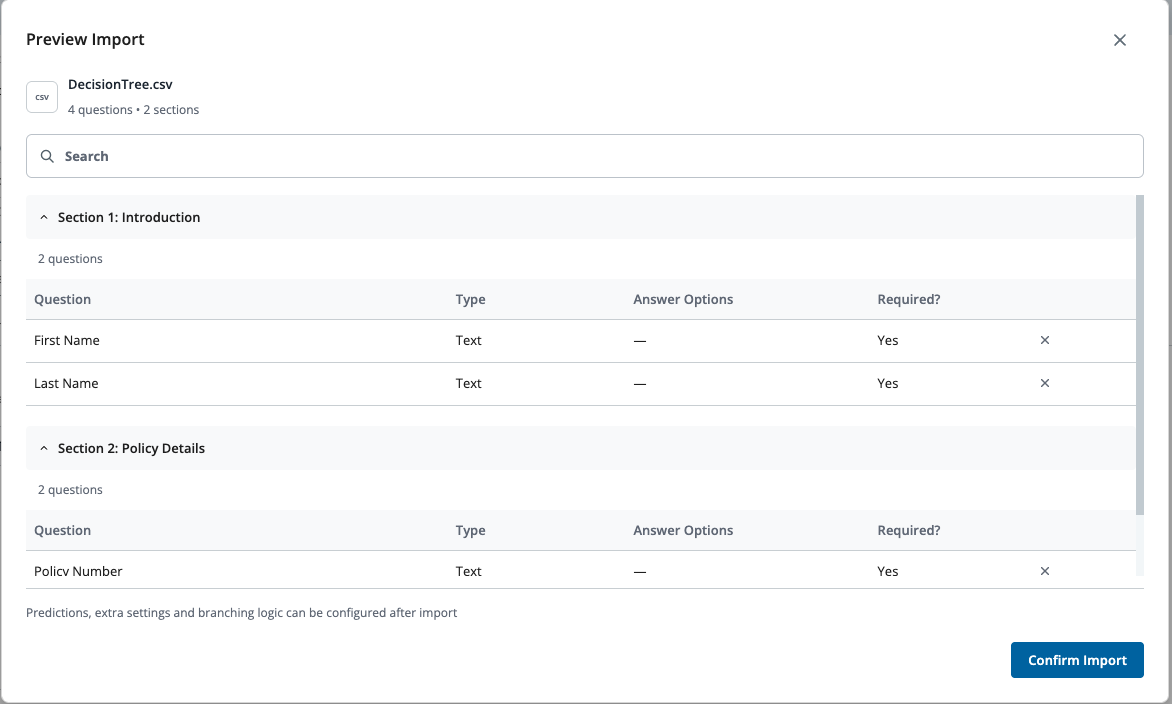
| Customer Request |
Yes |
UI Change |
Yes |
Availability | GA
On deploy |
Automatic Form Fill for Cognigy Workflows
Previously, automatic form fill was limited to the Copilot initial starter form.
In this release, Copilot automatically fills in form fields in workflow forms built in AI Agents (Cognigy). It uses three sources: the conversation transcript, the interaction context, and the output of workflows already run in the same session. You can:
-
Have fields filled in automatically as new information comes up in the conversation.
-
Trust that any edits you make as an agent are never overwritten by automatic fill.
This cuts down on repeated data entry across workflows built in AI Agents (Cognigy).
| Customer Request |
Yes |
UI Change |
Yes |
Availability | GA
On deploy |
Business Data in Copilot for Engagement Hub
Previously, Copilot on Engagement Hub (Multi-ACD/Open) did not have access to the caller context that calls routed by Studio already received.
In this release, when an Engagement Hub (Multi-ACD/Open) voice interaction The full conversation with an agent through a channel. For example, an interaction can be a voice call, email, chat, or social media conversation. starts, Copilot for Agents receives the caller's phone number, also called the ANI (automatic number identification). Copilot for Agents uses it as the customer ID for the interaction. You do not need to set anything up for this. You can use the caller's phone number to fill in context data in AI Agents (Cognigy) for Process Automation (Task Assist).
You can also use business data from your telephony system to decide when Copilot for Agents starts. To do this, add business data filters to your Real Time AI Policy. For details, see Real Time AI Policies.
| Customer Request |
No |
UI Change |
Yes |
Availability | GA
On deploy |
Agent Filters for Knowledge Hub Tags
Previously, Agent Filters only worked with the legacy Knowledge Hub Tags attribute. In this release, you can configure Agent Filters against any Knowledge Hub metadata attribute.
| Customer Request |
No |
UI Change |
No |
Availability | GA
On deploy |
Extended Knowledge Search Context Using Prior Questions
Previously, each knowledge base search started fresh from a short window of the recent conversation, so a follow-up question such as "what about the extended warranty for that?" could return incomplete results.
In this release, you can select a Context Strategy on the Knowledge tab of the Copilot for Agents profile, so Copilot uses earlier questions in the interaction The full conversation with an agent through a channel. For example, an interaction can be a voice call, email, chat, or social media conversation. to understand what a follow-up question refers to. You can:
-
Keep the default, Standard (Localized), where Copilot looks only at what was said since the last question it found.
-
Select Generated Questions to have Copilot remember the questions it already found earlier in the same interaction. Copilot uses them to turn a follow-up question, such as "What about the warranty for that?", into a complete search question.
-
Set how many earlier questions Copilot remembers in Number of Questions for Context, from 1 through 30. The default is 5.
This setting applies to voice interactions. Your changes apply to new interactions after you save.
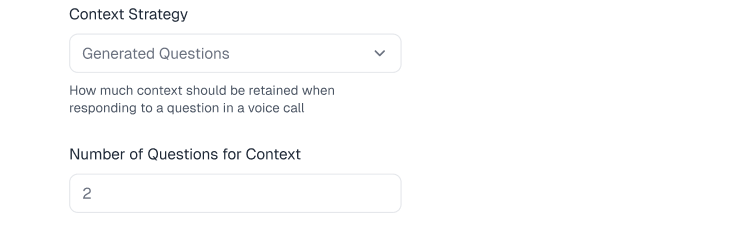
| Customer Request |
No |
UI Change |
Yes |
Availability | GA
On deploy |
Extended Knowledge Answers Using Prior Responses
Previously, even when Copilot took prior questions into account, follow-up answers did not consider what Copilot had already told the customer.
In this release, you can turn on Use Generated Answers on the Knowledge tab of the Copilot for Agents profile. Copilot then considers its own earlier answers when it writes a new one, so a follow-up answer builds on the earlier answer instead of repeating or contradicting it. You can:
-
Set how many earlier answers Copilot carries forward in Number of Answers for Context, from 1 through 10. The default is 3.
-
Get an answer that is consistent with what was already said, on related follow-up questions.
Use Generated Answers appears only when you select Generated Questions as the Context Strategy, and it is off by default. Copilot remembers answers only within one interaction The full conversation with an agent through a channel. For example, an interaction can be a voice call, email, chat, or social media conversation.. They do not carry into the next interaction, and agents cannot see what Copilot remembers.
| Customer Request |
No |
UI Change |
Yes |
Availability | GA
On deploy |
Dedicated Question Extraction for Digital Conversations
Previously, a digital message was sent to Knowledge Hub exactly as typed, so a long or rambling message could return results based on the entire text rather than the actual question.
In this release, Copilot can first extract the customer's actual question using a dedicated KB Query Extraction (Digital) prompt built for digital Any channel, contact, or skill associated with Digital Experience (DX). conversations. It then sends that question to the knowledge base instead of the whole message. You can:
-
Create and manage digital prompts in GenAI Prompts under the new KB Query Extraction (Digital) category.
-
Select the prompt in the new KB Query Extraction (Digital) Prompt drop-down on the Knowledge tab of the Copilot for Agents profile.
The existing category and drop-down are now called KB Query Extraction (Voice). Your existing voice prompt profiles stay in that category and work the same way.
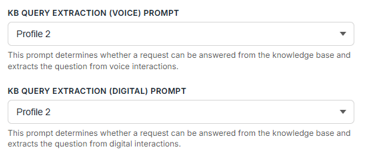
| Customer Request |
No |
UI Change |
Yes |
Availability | GA
On deploy |
Native Copilot Simulator in AI Studio
Previously, testing a Copilot configuration meant deploying it to a staging environment or using separate tools.
In this release, you can use Copilot Simulator in Test Suite to replay a past interaction The full conversation with an agent through a channel. For example, an interaction can be a voice call, email, chat, or social media conversation. through Copilot for Agents and see how Copilot responds. You can:
-
Load a past interaction by its contact ID, and review its details, its transcript, and the Copilot responses stored for it.
-
Replay the interaction through Copilot again and review the new responses as each message is processed.
Replays run in simulation mode. They do not create records in reporting or analytics, and they do not affect live interactions or agents.
This feature will be available later in the release cycle.
| Customer Request |
No |
UI Change |
Yes |
Availability | GA
On deploy |
Task Assist and Guided Capture for Engagement Hub
Previously, Task Assist and Guided Capture depended on Studio and were not available to agents working on Engagement Hub (Multi-ACD/Open).
In this release, Task Assist and Guided Capture work on Engagement Hub (Multi-ACD/Open), pulling caller information directly from it. You can:
-
Use Task Assist lookups and updates the same way you do on a call routed by Studio.
-
Run Guided Capture workflows on Engagement Hub (Multi-ACD/Open) calls for the first time.
| Customer Request |
No |
UI Change |
Yes |
Availability | GA
On deploy |
Silence Detection Trigger for Rules
Previously, rules could only trigger on keywords, phrases, or detected intent. You could not trigger a rule on silence.
In this release, you can configure a rule that fires when a voice interaction stays silent longer than a threshold you set. You can:
-
Choose whose silence triggers the rule: the customer, the agent, or either party. Set a threshold between 5 and 120 seconds. The default is 10 seconds.
-
Have the rule fire once per silence episode, so it does not fire again and again during one continuous silence.
This lets you catch dead air, prompt an agent who is stuck, or re-engage a quiet customer.
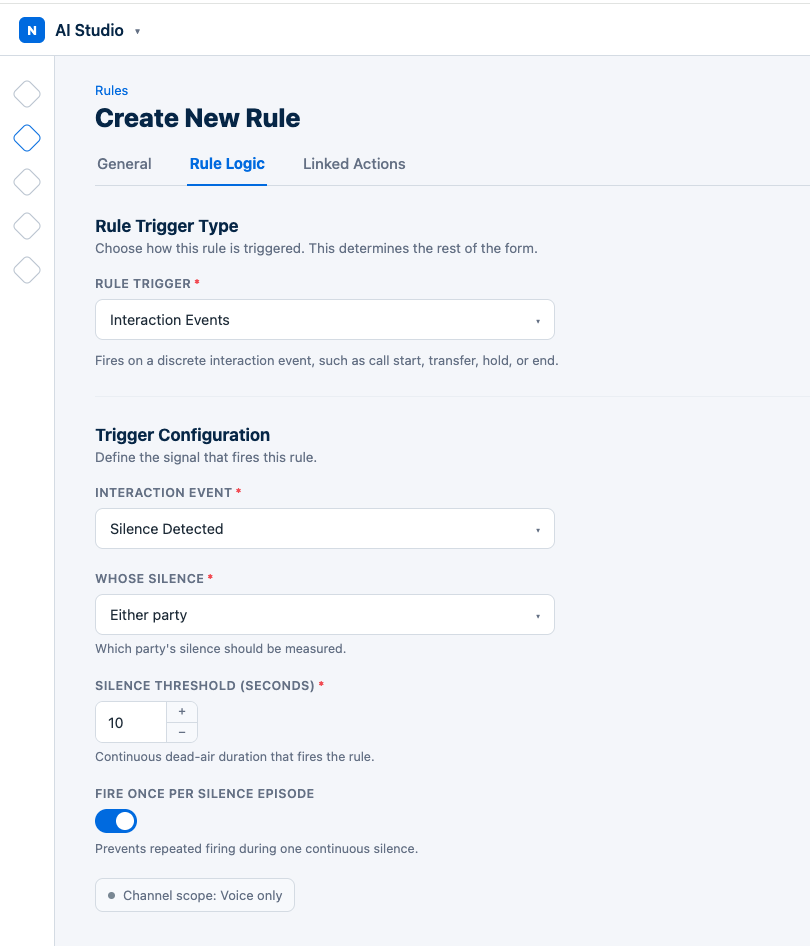
| Customer Request |
No |
UI Change |
Yes |
Availability | GA
On deploy |
Sentiment-Based Rule Triggers
Previously, rules could not trigger based on customer sentiment Overall mood or result of the interaction as determined by analysis of words, phrases, and context of the transcript..
In this release, you can configure a rule that fires on a sentiment state, a shift in sentiment, or sustained negative sentiment. You can trigger the rule on:
-
A sentiment state: Is Positive, Is Neutral, or Is Negative.
-
A shift from the previous reading: Improved, Declined, Improved Sharply, Declined Sharply, or Changed.
-
Sustained negative sentiment, with Held Negative. The rule fires after the customer stays Negative for the time you set, from 15 to 300 seconds. The default is 90 seconds.
Sentiment rules use the customer's sentiment and run only when Sentiment is turned on in the Copilot for Agents profile.
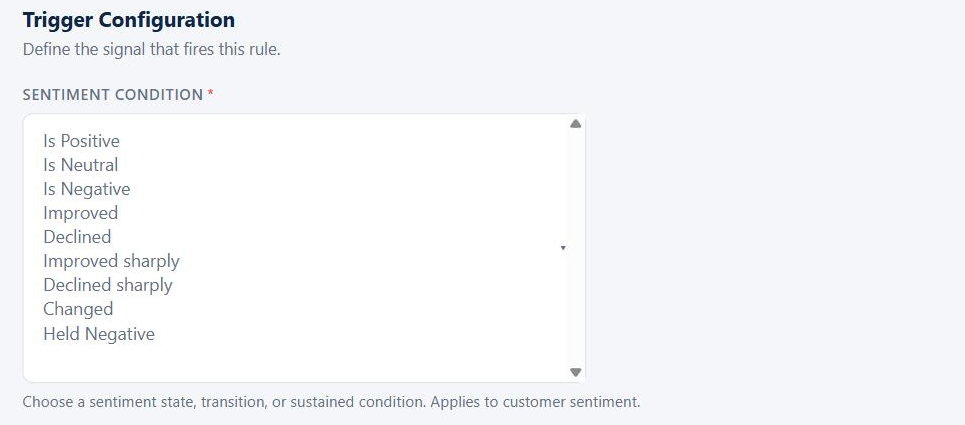
| Customer Request |
No |
UI Change |
Yes |
Availability | GA
On deploy |
Interaction Lifecycle Event Triggers for Rules
Previously, rules could not trigger on interaction The full conversation with an agent through a channel. For example, an interaction can be a voice call, email, chat, or social media conversation. events, such as a call transfer or a hold.
In this release, you can fire a rule on interaction events such as Interaction Started, Interaction Ended, Call Transferred, Hold Placed, and Hold Resumed.
| Customer Request |
No |
UI Change |
Yes |
Availability | GA
On deploy |
Division-Level Scoping for Rules
Previously, every rule was visible to every administrator, no matter which organizational unit they belonged to.
In this release, you can associate each rule with a division when you create it, so only users in that division Separate data securely between lines of business. Data can only be accessed from within the division it's part of. can see and manage it. You can:
-
Select a division from a new Division drop-down when you create a rule. You cannot change a rule's division after you create it.
-
Have existing rules mapped to the Default division automatically, with no migration steps on your part.
| Customer Request |
No |
UI Change |
Yes |
Availability | GA
On deploy |
Dashboard
Dashboard Global Filter
You can apply Global Filters at the dashboard level to update all compatible widgets at once. Widgets without compatible filters remain unchanged, and data does not refresh.
| Customer Request |
Yes |
UI Change |
Yes |
Availability | GA
On deploy |
Analytics Reports Improvements
Four analytics reports include new filtering options and reliability improvements, helping you find data easily and restoring trust in the results.
| Customer Request |
Yes |
UI Change |
Yes |
Availability | GA
On deploy |
API Usage Historical Report Enhancements
The API Usage Historical Report displays only external client application activity, providing a clearer and more accurate view of API usage.
| Customer Request |
No |
UI Change |
Yes |
Availability | GA
On deploy |
Dashboard Sharing: Select All Restored
You can now select All Teams when sharing dashboards in tenants High-level organizational grouping used to manage technical support, billing, and global settings for your NiCE CXone system. with fewer than 2,500 teams, simplifying sharing and reducing manual selection. Tenants with over 2,500 teams will continue to use search-based selection.
| Customer Request |
Yes |
UI Change |
Yes |
Availability | GA
On deploy |
New Outbound Call Metric
The new Outbound Contacts w/Active Time call metric classifies outbound calls consistently, improving reporting accuracy across dashboards and CDR exports.
| Customer Request |
Yes |
UI Change |
No |
Availability | GA
On deploy |
NiCE CXone Hierarchy Support
You can filter and group dashboard and report data by NiCE CXone hierarchy levels across supported domains, making it easier to analyze data by organizational structure.
| Customer Request |
No |
UI Change |
Yes |
Availability | GA
On deploy |
Data Share
Self-Service User Management
Hosted NiCE CXone Data Share customers now have a self-service User Management interface directly within the NiCE CXone platform, allowing you to create and remove Snowflake users autonomously without assistance from a NiCE CXone account representative. The new interface supports up to 50 active users per account (expandable upon request) and automatically provisions all new users under the secure DL_CUSTOMER role to ensure consistent access control and prevent unauthorized permission escalation.
| Customer Request |
Yes |
UI Change |
Yes |
Availability | GA
On toggle |
Outbound Engagement (SmartReach) Reporting Views in Snowflake Data Share
Data Share now includes Outbound Engagement (SmartReach) data by deploying standardized, production-ready Snowflake views. This enhancement provides you with direct access to campaign and attempt data, allowing analytics teams to query, join, and build custom dashboards directly in their Snowflake environment alongside other NiCE CXone datasets for granular performance tracking and omnichannel reporting.
| Customer Request |
Yes |
UI Change |
Yes |
Availability | GA
On toggle |
Operational Workforce Management (CXone) Data
Data Share now includes queryable historical operational WFM data directly within your Snowflake environment. You can access granular views covering schedule adherence, intraday performance (interval-level forecasted vs. actual metrics by skill and scheduling unit), and time utilization (activity durations mapped to payroll codes), alongside contextual dimensions such as agent states and skill groups. This empowers BI and analytics teams to correlate workforce performance with enterprise KPIs for deeper operational insights, trend analysis, and data-driven decision-making.
| Customer Request |
Yes |
UI Change |
Yes |
Availability | GA
On toggle |
Personal Connection Dataset
To ensure reporting continuity and expand self-service analytics, key Personal Connection outbound data, including Outbound Detail Records (ODR), are now available directly through Data Share. This provides seamless, direct access to essential outbound performance metrics, such as Outbound Handled Connects, Talk Time, Skill Time, Conversion Rates, and Abandon Rates. It enables teams to build custom dashboards, generate reports, and join outbound data alongside their broader NiCE CXone datasets in Snowflake without disruption to ongoing operations.
| Customer Request |
Yes |
UI Change |
Yes |
Availability | GA
On toggle |
Nexidia Analytics Data
Data Share now includes interaction-level Nexidia Analytics. You can access and query comprehensive interaction metadata, analytics results, query results, events, and Enlighten scores and intents, which enables BI and analytics teams to correlate deep interaction insights directly alongside their broader NiCE CXone datasets for unified enterprise reporting, customer journey analysis, and downstream analytics.
| Customer Request |
Yes |
UI Change |
Yes |
Availability | GA
On toggle |
Desktop Analytics: Injected Activity Flag in Data Share Views
The Data Share Desktop Analytics coverage now includes the IS_INJECTED boolean A data type that has two possible values: true and false. field in the existing DESKTOP_APPLICATION_PAGE_ACTIVITY_FACT_VIEW_V001 and DESKTOP_APPLICATION_ACTIVITY_FACT_VIEW_V002 Snowflake views. This enhancement enables organizations querying Desktop Analytics data to programmatically identify and filter injected activity events alongside organic agent interactions, providing greater precision and visibility into automated and simulated desktop workflows within custom reporting and business intelligence models.
| Customer Request |
No |
UI Change |
No |
Availability | GA
On toggle |
MCR Segment data in Data Share
Recording Management (CXone) customers can now access their interaction and segment metadata through Data Share, including segment identifiers, timestamps, interaction The full conversation with an agent through a channel. For example, an interaction can be a voice call, email, chat, or social media conversation. duration, channel Various voice and digital communication mediums that facilitate customer interactions in a contact center., direction, recording status, hold details, disposition, business data tags, and recording alerts. Data Share complements, rather than replaces, the existing Data Extract API and it covers interaction metadata only. It does not include audio or screen recording media files.
| Customer Request |
No |
UI Change |
No |
Availability | GA
On toggle |
Enlighten AI Routing Data
Data Share now includes Enlighten AI Routing data for tenants High-level organizational grouping used to manage technical support, billing, and global settings for your NiCE CXone system. that use Enlighten AI Routing. For each contact sent to Enlighten AI Routing, you can see whether the contact The person interacting with an agent, IVR, or bot in your contact center. was routed to the recommended agent and which routing focus metric was in effect. You can use this data alongside your other NiCE CXone contact data to measure Enlighten AI Routing usage and impact. The data is available through the AIROUTING_REFINED.CONTACT_ROUTING_INFLUENCE_FACT_VIEW_V001 view.
| Customer Request |
No |
UI Change |
No |
Availability | GA
On toggle |
Data Streams
Agent Session Event Streaming
Previously, agent session event data from NiCE CXone was not available for direct external consumption through Data Streams. Customers who needed near-real-time visibility into agent activity had to rely on other reporting mechanisms.
In this release, Data Streams publishes the Agent Session events for external customer consumption. The Agent Session stream delivers enriched, event-level agent session data in near-real time. Each record includes the agent's display name, state display name, session and state timestamps, and unavailable-state details. Tenant ID and Division Number are included for data security and customer-level stream isolation. Agent Session event streaming needs to be enabled by a NiCE CXone account representative and is not available for customer selection or self-service enablement in the Data Streams user interface in this release.
This capability unlocks near-real-time agent session event data for external consumption, empowering customers with live workforce insights while reducing dependency on batch reporting and third-party data workarounds.
| Customer Request |
Yes |
UI Change |
No |
Availability | GA
On toggle |
Desktop Discovery
Node Watch and Troubleshoot Data Enhancements
Administrators and supervisors can select specific dates to retrieve and troubleshoot agent logs, moving beyond the current limitation of viewing only today's data. The Node Watch grid is updated to include agent hostnames and clearer task status labels to improve visibility and diagnostic efficiency.
| Customer Request |
No |
UI Change |
Yes |
Availability | GA
On deploy |
Configuration Manager Audit Trail
Administrators and supervisors can view a comprehensive change history for Desktop Discovery configurations, including details on who made changes and when they occurred. This feature provides clear visibility into parameter updates, team assignments, and configuration status transitions through a new interactive timeline, among other audit events.
This feature is available only in 26.4 and higher releases.
| Customer Request |
No |
UI Change |
Yes |
Availability | GA
On deploy |
Activity Management and Tracking
Administrators can define, manage, and organize off-desktop activities and pre-defined business processes in Desktop Discovery. Users can then select and report these activities through the Desktop Discovery Client, providing greater visibility into work performed outside standard desktop applications.
| Customer Request |
No |
UI Change |
Yes |
Availability | GA
On deploy |
Desktop Discovery Metrics Update
The calculation method for Desktop Discovery metrics is changed to provide a more accurate representation of user activity. The App Productive Time, App Non-Productive Time, and Uncategorized App Time metrics transition to using page activity duration as the primary data source for time calculations.
| Customer Request |
No |
UI Change |
Yes |
Availability | GA
On deploy |
Web Proxy Support for Desktop Discovery Client
Administrators can configure the Desktop Discovery Client to route outbound traffic through corporate proxy infrastructure using system settings, PAC scripts, or manual configurations. This update ensures seamless connectivity for users operating within secured enterprise network environments.
| Customer Request |
No |
UI Change |
No |
Availability | GA
On deploy |
Configurable Application Collection and Preprocessing Policies
Administrators will soon have granular control over data collection and preprocessing for specific applications using new block-list and allow-list capabilities. This feature will allow for the suppression of duplicate data in remote-session environments like Citrix and enable application-specific data sanitization to meet precise compliance requirements.
| Customer Request |
No |
UI Change |
Yes |
Availability | GA
On deploy |
Local Files Retention and Cleanup
Desktop Discovery includes an automated cleanup service that manages local message files on client machines to optimize disk space. This feature automatically removes stale, failed, invalid, or tampered message files that exceed a configurable retention period (defaulting to 90 days) every time the client starts.
| Customer Request |
No |
UI Change |
Yes |
Availability | GA
On deploy |
Digital Experience (DX)
Audit History for Workflow Automation Entities
You can view a full audit history of changes to workflow automation entities in two BI reports: Activity Audit History and Change Audit History. Audit is available for triggers, schedulers, jobs, and conditions, and for role-based, channel-level permissions. Each audit entry shows the changed field, the old and new values, who made the change, and when it happened. This gives you better visibility into who changed these entities and makes it easier to trace the source of an unexpected change.
| Customer Request |
No |
UI Change |
No |
Availability | Preview
On toggle |
100 MB Attachments for All Digital Channels
Live Chat, Email, Secure Messaging, and Internal Chat (Conversations) now support file attachments up to 100 MB, matching the limit already available on Apple Messages for Business. Agents, bots, and contacts can send up to 50 attachments in a single message, as long as the combined size of all the attachments doesn't exceed 100 MB. If an attachment is too large or an unsupported file type, the sender sees a clear error message instead of a silent failure.
This feature will be enabled gradually across regions by tenant throughout the 26.4 and 27.1 release cycles.
| Customer Request |
Yes |
UI Change |
No |
Availability | GA
On toggle |
Bring Your Own Channel (BYOC) Availability by Tier
Starting with tenants set up under the Digital Experience (DX) Monetization Model, Bring Your Own Channel (BYOC) is available only on the higher of two Digital Experience (DX) tiers. This change only impacts new customers. Existing customers are not affected.
| Customer Request |
No |
UI Change |
Yes |
Availability | GA
On toggle |
Per-Contact Inbound Message Rate Limit
You can turn on a rate limit for inbound messages from a single contact The person interacting with an agent, IVR, or bot in your contact center. to a brand. When it's on, messages from a contact that exceeds the limit within a set time window are rejected until the limit resets. Messages from other contacts to the same brand aren't affected. This is designed to keep one contact's messages from overwhelming a brand's inbound message pipeline and affecting service for everyone else. For example, messages sent from a malfunctioning integration or a spam source.
| Customer Request |
No |
UI Change |
No |
Availability | GA
On toggle |
Legacy Digital Experience (DX) UI No Longer Available
The legacy Digital Experience (DX) UI (CRM tab and Care page (under Others > Digital)) was decommissioned with the 25.4 release. New customers do not have access to these pages. Most features that were available in the legacy UI are now available in Agent Workspace (Agent).
| Customer Request |
No |
UI Change |
No |
Availability | N/A |
Digital Chat
Implicit Flow for Third-Party Authentication
Script developers integrating the chat window can now use an implicit OAuth flow for third-party authentication, in addition to the existing authorization code flow. With implicit flow, the host page passes an access token directly instead of an authorization code, and NiCE CXone validates that token before issuing a transactional token for the chat session. Both flows remain available at the same time, and no channel settings changes are required to use either one. Because the host page is fully responsible for token validity under implicit flow, this option gives you more control over verifying a user's identity.
| Customer Request |
Yes |
UI Change |
No |
Availability | GA
On toggle |
Persistent Menu for Cognigy-Integrated Bots
You can offer a persistent menu in the digital chat window when you have use a Cognigy AI bot. A persistent menu gives contacts The person interacting with an agent, IVR, or bot in your contact center. quick-action buttons they can use to navigate between conversation stages at any point in the conversation.
This capability is only available for bots built through Cognigy AI. It is not available to live agents or to bots outside the Cognigy AI integration. Each channel must be mapped to a specific Cognigy AI endpoint. The menu itself is configured entirely on the Cognigy AI side.
| Customer Request |
No |
UI Change |
Yes |
Availability | GA
On toggle |
AI Bot Reply Streaming for Cognigy-Integrated Bots
For bots built on the AI Agents (Cognigy) solution, when an AI-generated reply arrives as a series of separate messages sent sentence by sentence, digital chat displays and animates them together as a single, smoothly growing response instead of showing each sentence as its own separate message.
This capability is only available for bots built through Cognigy AI. It is not available to live agents or to bots outside the Cognigy AI integration.
This feature will be available later in the release cycle.
| Customer Request |
No |
UI Change |
Yes |
Availability | GA
On toggle |
xApp Support for Cognigy-Integrated Bots
For bots built on the AI Agents (Cognigy) solution, digital chat supports xApps. The xApps option offers small self-service web applications that a bot can present to the contact inline in the chat window or in a separate browser tab. Cognigy AI defines what an xApp does and how it looks. The role of NiCE CXone digital chat is to display it. Example use cases include verifying identity, selecting a seat, sharing a location, or capturing a signature.
This capability is only available for bots built through Cognigy AI. It is not available to live agents or to bots outside the Cognigy AI integration.
| Customer Request |
No |
UI Change |
Yes |
Availability | GA
On toggle |
HTML Content Support
Agents can send quick responses formatted as HTML or complex HTML in interactions on digital chat channels. Previously, these quick responses were hidden from agents. Digital chat also processes incoming messages sent with an HTML content type. Rendered HTML content is isolated from the surrounding chat window styles so it displays consistently. The rich text editor used to create quick responses supports inserting hyperlinks, and agents see the destination URL before sending. All HTML content is sanitized on both the client and the server, and links are only allowed to use standard http and https addresses.
This option is only available to agents using Agent Workspace (Agent). Rendering of HTML only works from the agent side, not the contact side.
This feature will be available later in the release cycle.
| Customer Request |
Yes |
UI Change |
Yes |
Availability | GA
On toggle |
JavaScript API to End a Live Chat Session
Script developers integrating the digital live chat widget can use a new JavaScript API method to explicitly close the active live chat interaction from the hosting web page. Closing a session this way also clears the stored session pointer so the closed session isn't automatically rejoined if the page reloads. No replacement session is created unless the hosting application starts one. This change also fixes an existing issue where a closed interaction's session pointer could remain in browser storage and cause repeated, failed rejoin attempts on every page reload.
This change applies to the digital live chat channel only. Asynchronous messaging channels are not affected, because messaging contacts cannot be closed this way.
| Customer Request |
Yes |
UI Change |
No |
Availability | GA
On toggle |
Digital Email Channels
Case-Specific Bounce-Back Messages for Rejected Emails
When NiCE CXone can't process an inbound email, the sender receives a bounce-back message that explains the specific reason, instead of one generic failure message. This helps senders understand issues like content or attachment problems and correct them without contacting support. Bounce-back messages are initially available in English only. This change is only for SES/DFO-based accounts. Support for bounce-back messages will be added for Graph API customers in a future release.
| Customer Request |
No |
UI Change |
No |
Availability | GA
On deploy |
Outbound Subject Line Now Reflects Agent/Supervisor Edits
When an agent replies to a contact's email and edits the subject line before routing it through the Supervisor Approval workflow, the subject of the email that the patron receives now correctly reflects that edit. Previously, emails sent via Supervisor Approval sometimes showed an unrelated, system-generated subject instead of the agent's intended one, even though the change was correctly reflected when the same reply was sent directly without approval routing. This change corrects the outbound email payload, so the approved subject line is consistently honored, regardless of which send path is used.
| Customer Request |
Yes |
UI Change |
No |
Availability | GA
On deploy |
Messaging and Social Channels
Contact Name Improvement for Apple Messages for Business
Previously, contacts on Apple Messages for Business channels displayed with a generic label in Agent Workspace (Agent) applications instead of with the contact's name. This made it hard for agents to tell the contacts apart when they had more than one Apple Messages for Business contact at a time. In this release, agents see the contact's name, just as they do for interactions on other digital channels.
Additionally, agents can change a contact's name for interactions on channels where the provider doesn't send a reliable name, such as Apple Messages for Business. For more details, select Agent Workspace (Agent) from the filter on the right.
Neither change impacts the contact or the contact's side of the conversation. Only agents using Agent Workspace (Agent) will notice a change.
| Customer Request |
Yes |
UI Change |
Yes |
Availability | GA
On deploy |
Identity Verification Via Apple Messages for Business
NiCE CXone now supports using the built-in Apple authentication flow with Apple Messages for Business channels. The Apple authentication flow uses the latest OAuth Authorization framework. This framework is compatible with Open ID Connect. It allows you to securely authenticate the identity of contacts instead of asking for account credentials or other sensitive information directly in the conversation.
Authentication messages can be sent from Agent Workspace (Agent), by Studio, and by virtual agents or other applications. When an authentication message is sent, Apple delivers the template to the contact's device. When the contact taps the message, they go through the secure sign-in flow that you will build with your OAuth provider. This verifies the contact's identity. The agent receives confirmation of which account the contact logged in to.
If you want to use the Apple authentication flow, you need to:
- Build and deploy a flow with an OAuth provider.
- Supply the required details about the OAuth provider in the Apple Business register in the Integrated OAuth 2 Authentication section.
- Create Authentication message templates in your Apple Messages for Business channel settings.
| Customer Request |
Yes |
UI Change |
Yes |
Availability | GA
On deploy |
Apple Messages for Business Invitations
You can configure Invitation templates in Apple Messages for Business channel settings. This allows your organization to proactively start conversations with contacts over Apple Messages for Business using a template that Apple has approved for your account. Apple requires individual approval of both your organization and its templates before Invitations can be used. To secure this approval, reach out to your NiCE CXone account representative.
Contacts need to provide your organization explicit opt-in messaging to the provided phone number before the invitation is sent. Contact opt-out requests must be respected.
You can send Invitations in two ways, either automatically via Studio script or manually by agents using Agent Workspace (Agent). You can create Scripts and virtual agents need to be configured to handle 404 error responses. Invitations sent to non-Apple devices return 404 errors.
These branded and verified Invitations appear in the Messages app on Apple devices. This allows the contact to engage with your organization in secure, private conversations. If the contact doesn't have an existing conversation with your organization, the system creates a new one. If the contact responds to the Invitation, the conversation becomes a normal two-way Apple Messages for Business conversation. If the contact has an existing Apple Messages for Business conversation with your organization, the Invitation appears in the same conversation thread.
| Customer Request |
No |
UI Change |
Yes |
Availability | GA
On toggle |
Contact Card Support For WhatsApp
Agents and contacts can share contact information, such as name and phone number, during WhatsApp conversations. When agents send contacts a vCard in WhatsApp conversations, NiCE CXone converts the vCard to the WhatsApp contact format so that the contact can seamlessly add that contact into their WhatsApp contacts list. When contacts share a contact with agents in a WhatsApp conversation, NiCE CXone converts the WhatsApp contact to a vCard, which is available to the agent as an attachment. This feature brings NiCE CXone in line with a standard WhatsApp messaging feature.
| Customer Request |
Yes |
UI Change |
Yes |
Availability | GA
On deploy |
Request Phone Number In WhatsApp Templates
You can send rich messages over WhatsApp that include a button that asks the contact to share their phone number. When a contact taps the button to respond, NiCE CXone captures the phone number and display it to the agent in a system message. This allows your agents to fill in gaps in your contact records.
The WhatsApp utility and marketing templates in the WhatsApp Manager allow you to add this button type. However, NiCE CXone does not yet sync template messages with the request-contact-info button type. This ability will be added in a future release. In this release, this option must be configured in your Studio scripts.
| Customer Request |
No |
UI Change |
No |
Availability | Preview
On toggle |
Request Location Over WhatsApp
Agents can request a contact's current location during WhatsApp conversations. When contacts share a location during the conversation, NiCE CXone shows agents a system message with the shared location's GPS coordinates and a URL to view those coordinates in an open source map. The map opens in another browser tab. If the contact includes other information, such as a name and address, the agent also sees that information.
Live location sharing is not supported in WhatsApp Business Messaging. Contacts can only share:
- A static location pin that indicates where they are at the moment they send the message. The location will be shared as GPS coordinates.
- An address pin selected after searching for a street address in WhatsApp. The location will be shared as GPS coordinates and street address.
- The pin for a nearby place found in the WhatsApp location search, such as a business, park, or monument. The location is shared as GPS coordinates, street address, and the name of the location.
| Customer Request |
Yes |
UI Change |
Yes |
Availability | GA
On deploy |
Receive Location Over WhatsApp
Agents can send rich messages over WhatsApp that include a button that asks the contact to share their location. When the contact taps Send Location in the message, WhatsApp prompts the contact to send their current GPS coordinates or to search and select from a list of known nearby places. When NiCE CXone receives the location, the system displays it to the agent. This feature streamlines the process for contacts to share locations during time-sensitive conversations, such as roadside assistance or insurance claims. In this release, this option must be configured in your Studio scripts.
| Customer Request |
Yes |
UI Change |
Yes |
Availability | GA
On deploy |
WhatsApp Username as Contact Display Name
Currently, for interactions on WhatsApp Business channels, agents see the contact's phone number instead of a username. In this release, agents see the contact's WhatsApp username as their display name when it's available, instead of their phone number. If a contact doesn't have a username, agents continue to see their phone number as before. When a username is shown, the contact's phone number is still available to the agent, but it is not available for agents to see. Making the phone number accessible for agents to see will be added in a future release.
| Customer Request |
No |
UI Change |
Yes |
Availability | GA
On deploy |
Mobile SDK
Landscape and Wide Screen Support
The Mobile SDK chat experience now supports landscape orientation on iOS and wide screen layouts on Android, including large-screen and foldable devices. Chat, attachments, and other conversation elements adapt automatically so contacts get a consistent experience no matter how they hold or unfold their device.
| Customer Request |
No |
UI Change |
Yes |
Availability | GA
On deploy |
Satisfaction Survey Pop-Up Support
Previously, when a satisfaction survey was delivered as HTML plugin content, the Mobile SDK couldn't display it and contacts saw an "unsupported message content" message instead of the survey. In this release, the SDK shows these surveys in a pop-up window so customers can rate their experience and submit comments, in both digital live chat Agents and contacts interact on a real-time basis. and chat messaging Asynchronous chat in which contacts send a chat message anytime and wait for a reply. conversations. This allows you to obtain survey responses from contacts on channels built with the SDK.
| Customer Request |
No |
UI Change |
No |
Availability | GA
On deploy |
PKCE Support for OAuth Login
The SDK for iOS and Android can sign customers in through a third‑party identity provider using the OAuth Authorization Code flow with PKCE. The mobile app acts as a public client, so no client secret is stored in the app. After a successful sign‑in the contact sees the normal chat experience.
The flow works with any identity provider that supports Authorization Code with PKCE. Google is the provider validated for this release. Others are expected to work but were not validated in this release.
To use this flow, register a public (native) OAuth client without a secret at your identity provider and make sure the channel's OAuth configuration includes the Redirect URI.
| Customer Request |
No |
UI Change |
No |
Availability | GA
On deploy |
ChannelInfo Caching
The SDK caches channel information locally for five minutes instead of requesting it from NiCE CXone every time a contact opens the app, changes screens, or starts a chat. This gives you faster app performance.
The SDK refreshes the cached information automatically after five minutes, or immediately when a contact logs out or the app reinitializes with a different channel ID. If you change a channel's settings in NiCE CXone, the update takes up to five minutes to appear in the app because of this cache.
To start caching channel information, you need to update to the latest SDK version. No additional code changes are required. The five-minute TTL time cannot be modified.
| Customer Request |
No |
UI Change |
No |
Availability | GA
On deploy |
Enhanced Strategic Planner
New Hire Learning Curve
Enhanced Strategic Planner lets you model the new hire ramp-up period directly in your long-term plans.
You can define how productive new hires are during each week of their training period by setting the training duration, AHT, % Productive, and working days per week, and see the impact on AHT, FTE, coverage, and cost. This feature gives detailed training metrics and clearer visibility into new hire productivity.
| Customer Request |
Yes |
UI Change |
Yes |
Availability | GA
On toggle |
Export and Import Plan Data as Excel Files
Enhanced Strategic Planner lets you export plan data to an Excel file, edit the data offline, and import it back into the plan. This feature helps you update specific parts of a plan without regenerating a long-term forecast.
| Customer Request |
Yes |
UI Change |
Yes |
Availability | GA
On toggle |
Accessibility Improvements
Enhanced Strategic Planner includes significant accessibility improvements designed to offer a smoother, more inclusive experience for users across a wide range of visual, motor, and cognitive needs.
| Customer Request |
Yes |
UI Change |
Yes |
Availability | GA
On toggle |
Australia Public Cloud Availability
Enhanced Strategic Planner is available for deployment in the Australia Public Cloud for NiCE WFM customers. The configuration supports scalability, resiliency, and compliance.
This will be available later in the release cycle.
| Customer Request |
Yes |
UI Change |
No |
Availability | GA
On toggle |
Feedback Management
Flexible SMS Survey Timeouts
You are able to set shorter timeout periods for surveys, configured in minutes, hours, or days. This change provides the flexibility needed for conversational API-powered digital surveys, ensuring they align better with real-time customer interactions.
You can update these settings in the survey properties. The field label is Survey Session Time Out. The default timeout is two days for new surveys. Existing surveys keep their current settings unless you manually adjust them.
| Customer Request |
Yes |
UI Change |
Yes |
Availability | GA
On deploy |
Survey Support for Cognigy AI Interactions
Customers who use NiCE CXone and Cognigy AI are now able to collect feedback through Feedback Management after voice or digital Any channel, contact, or skill associated with Digital Experience (DX). interactions with Cognigy AI Agents, including interactions The full conversation with an agent through a channel. For example, an interaction can be a voice call, email, chat, or social media conversation. that start with an AI agent and escalate to a human agent.
| Customer Request |
Yes |
UI Change |
Yes |
Availability | GA
On deploy |
Accessibility Improvements
Feedback Management pages include significant accessibility improvements designed to offer a smoother, more inclusive experience for users across a wide range of visual, motor, and cognitive needs.
| Customer Request |
Yes |
UI Change |
Yes |
Availability | GA
On deploy |
Speech-to-text engine version upgrade
The speech-to-text engine version is being upgraded. Your existing language configurations will be preserved, and no action is required. For more information, contact your Technical Account Manager.
| Customer Request |
No |
UI Change |
No |
Availability | GA
On deploy |
GenAI Prompts
Instant Profile Search
Previously, finding a specific profile in GenAI Prompts meant scrolling through the full list of profiles one by one.
In this release, you can search for a profile by name directly in GenAI Prompts, the same way you already search for profiles in Copilot. Matching results appear as you type, without pressing Enter or a search button, so you can find what you need without breaking your flow.
| Customer Request |
No |
UI Change |
Yes |
Availability | GA
On deploy |
Gradual Rollout for Updated Prompt Templates
Previously, when NiCE updated a prompt template, you were switched to the new version automatically and without notice, with no chance to test it first.
In this release, you are notified when a prompt template you use is updated, and you can keep testing the previous version before you decide to adopt the new one. You can:
-
Get notified as soon as an updated template is available for a prompt you use, instead of being switched over silently. This lets you see changes before they affect your live prompts.
-
Keep testing the current template alongside the new one for a period of time before you publish the update. This lets you validate the new version on your own schedule.
This gives you control over when you adopt a template change, instead of an unannounced switch to a new version.
This feature will be available later in the release cycle.
| Customer Request |
No |
UI Change |
Yes |
Availability | GA
On deploy |
Bring Your Own LLM for Cognigy AI
Previously, Cognigy AI was limited to the language models NiCE provided, with no way to connect a model of your own.
In this release, you can connect your own large language model (LLM Large Language Model. A type of AI that processes, understands, and generates human language based on context.) to Cognigy AI instead of relying only on the models that NiCE provides. This gives you choice and control over the model behind your Cognigy AI environment.
This feature will be available later in the release cycle.
| Customer Request |
No |
UI Change |
Yes |
Availability | GA
On deploy |
AI Assist Expands Beyond Automated Summary (AutoSummary)
Previously, AI Assist only supported Automated Summary (AutoSummary) prompts.
In this release, AI Assist supports your prompts more broadly, draws on a wider knowledge base, and lets you compare how a prompt performs across different language models. You can:
-
Get guidance from AI Assist that draws on Online Help and training documentation, for more accurate suggestions when you configure your prompts.
-
Try your prompt against a different LLM
Large Language Model. A type of AI that processes, understands, and generates human language based on context. and see a before-and-after comparison of the results, the same way you already can for Automated Summary (AutoSummary).
This turns AI Assist from a single-purpose Automated Summary (AutoSummary) helper into a broader assistant for your day-to-day prompt configuration work.
This feature will be available later in the release cycle.
| Customer Request |
No |
UI Change |
Yes |
Availability | GA
On deploy |
Test Email-Based Prompts Directly in GenAI Prompts
Previously, you could customize and publish email-based prompts in GenAI Prompts, but you could not test them first.
In this release, you can test email-based prompts directly in GenAI Prompts using a dedicated Email tab, the same way you test other prompt types. You can:
-
Retrieve and review email content directly in GenAI Prompts before you test it.
-
Test your email-based prompt and review the results before you publish it, instead of publishing it first and finding out how it performs afterward.
This lets you validate email-based prompts with the same confidence you have for every other prompt type.
This feature will be available later in the release cycle.
| Customer Request |
No |
UI Change |
Yes |
Availability | GA
On deploy |
Search and Select Transcript Segments
Previously, adding a transcript to GenAI Prompts means entering a segment ID manually.
In this release, you can:
-
Search for a segment the same way you search elsewhere in the product, instead of finding and typing an ID.
-
Select the right segment with confidence, without copying IDs from another screen.
This feature will be available later in the release cycle.
| Customer Request |
No |
UI Change |
Yes |
Availability | GA
On deploy |
LLM Manager for Copilot Prompts and Custom Prompts
Previously, GenAI Prompts profiles could only use a fixed set of platform models, and you could not see which models were available.
In this release, the LLM Manager, which you open from the Settings icon in the GenAI Prompts header, lets you view all available models. You can also add your own model by providing its API key, endpoint, and version, instead of being limited to the models that NiCE provides.
This gives you visibility and direct control over which model powers each prompt, plus the option to bring your own when you need to.
This feature will be available later in the release cycle.
| Customer Request |
No |
UI Change |
Yes |
Availability | GA
On deploy |
Premium Model Selection Unlocked in GenAI Prompts
Previously, Premium large language model (LLM Large Language Model. A type of AI that processes, understands, and generates human language based on context.) selection in GenAI Prompts was locked and not available to you.
In this release, you can select Premium large language models directly in GenAI Prompts. You can:
-
Choose a Premium LLM for your prompts instead of being limited to Standard models.
-
Select a Premium LLM only if your tenant has the LLM consumption-based billing SKU.
-
See usage billed with a transparent, token-based model that reflects your actual Premium usage.
This gives you direct access to Premium model options that were not available before.
| Customer Request |
No |
UI Change |
Yes |
Availability | GA
On deploy |
Guide
Content Security Policy Support for the Guide Script
Previously, if your website enforced a Content Security Policy (CSP) with nonce-based script permissions, the Guide script could be rejected as a CSP violation, even when it used a valid nonce generated by your server.
In this release, the Guide script loader accepts and correctly passes along nonce values generated by your server, so Guide works in strict CSP environments. You can load Guide on sites with strict, nonce-based Content Security Policies without causing a CSP violation.
This removes a compatibility barrier for security-conscious customers who enforce a strict CSP and could not deploy Guide without a policy exception before.
This feature will be available later in the release cycle.
| Customer Request |
No |
UI Change |
No |
Availability | GA
On deploy |
Custom Visitor Events for Reporting
Previously, custom events that you sent from Guide were not captured in reporting, so you could not use them to analyze visitor activity.
In this release, custom events that you send from Guide using the existing JavaScript API, for example, setVisitorEvent('page_view', window.location.pathname)are recorded and made available through Data Share. You can:
-
Send custom visitor variables and events from Guide using the API calls you already have in place.
-
Query those custom events in the Guide visit activity view in Data Share, instead of having them go uncaptured.
Guide adds custom. to the start of each event name. Keep event names to 23 characters or fewer, or the event is not saved.
This closes a gap between what you can already send from Guide and what you can report on, and gives you fuller visibility into visitor activity.
| Customer Request |
No |
UI Change |
No |
Availability | GA
On deploy |
Clear Visitor Data with a New Purge Command
Previously, there was no supported way to fully clear a visitor's stored data and active chat session on demand.
In this release, a new command lets you purge a visitor's stored data, which clears their local visitor and visit data along with any active conversation and stored custom fields, and start a fresh session without reloading the page. You can:
-
Purge a visitor's stored data and reset their active chat session with a single call, instead of relying on a page reload or a manual workaround.
-
Start a new session right after the purge, with no active conversation or custom fields carried over.
This gives you a supported way to fully reset a visitor's data and session, which is especially useful on shared or public devices.
This feature will be available later in the release cycle.
| Customer Request |
Yes |
UI Change |
No |
Availability | GA
On deploy |
Accessibility and Usability Improvements for the PreContact Survey
Previously, the precontact survey showed validation errors on all required fields as soon as the form loaded, before a visitor had any chance to fill it in.
In this release, validation errors appear only after a visitor tries to submit the form with required fields still empty, and each error clears as soon as that field is filled in. This release also fixes several related accessibility issues, so the survey works better with assistive technology. Your visitors can:
-
See validation errors only after they try to submit the form, instead of when the page loads, with errors clearing in real time as they complete each field.
-
Use the survey's buttons and icons with assistive technology more reliably, because labels and roles on form elements are corrected.
These changes remove a confusing experience for every visitor who opens the precontact survey and make the survey more accessible for visitors who use assistive technology.
| Customer Request |
Yes |
UI Change |
Yes |
Availability | GA
On deploy |
Interaction Analytics (CXone)
Copilot for Analytics Accessibility Support
The Copilot for Analytics will include significant accessibility improvements designed to offer a smoother, more inclusive experience for users across a wide range of visual, motor, and cognitive needs.
| Customer Request |
No |
UI Change |
No |
Availability | GA
On deploy |
Support for New Operators in Metrics Category Rules
Previously, category rules based on numeric metrics could use only the equal to, greater than, and less than operators. In this release, Interaction Analytics (CXone) adds the greater than or equal to (>=) and less than or equal to (<=) operators for numeric metrics in category rules. This gives you more precise control when you define thresholds, such as including interactions at exactly the value you set. Existing category rules aren’t affected.
| Customer Request |
No |
UI Change |
Yes |
Availability | GA
On deploy |
Copilot for Analytics Enhancement
Tenants can turn off Copilot for Analytics if they choose.
| Customer Request |
No |
UI Change |
Yes |
Availability | GA
On deploy |
Interactions Hub
Redaction Indication in Search
Supervisors, evaluators, and managers can now clearly identify when interaction The full conversation with an agent through a channel. For example, an interaction can be a voice call, email, chat, or social media conversation. media has been redacted and understand when part of the content is unavailable for review. A new redaction column supports filtering, helping improve review workflows and compliance tracking.
| Customer Request |
No |
UI Change |
Yes |
Availability | GA
On deploy |
Increased Trial Policy Limit
Users can now create up to 10 trial data policies, increasing the previous limit of one policy. The expanded trial limit makes it easier to evaluate Data Policy capabilities while keeping the existing interaction limit per policy.
| Customer Request |
No |
UI Change |
Yes |
Availability | GA
On deploy |
Policies Grid Filtering
Users can now filter the Policies grid by Updated Date, Policy Type, and Status, making it easier to locate and manage specific data policies. Multiple filters help improve navigation and reduce manual scanning, while the clear filters option lets users reset the grid to its default view.
| Customer Request |
Yes |
UI Change |
Yes |
Availability | GA
On toggle |
Accessibility Support for 200% Zoom
Users can now use Data Policy pages at 200% browser zoom with improved layout, readability, and accessibility. Page content, section titles, and interactive elements remain visible and usable, helping users access key functionality without content being clipped or hidden.
| Customer Request |
Yes |
UI Change |
Yes |
Availability | Preview
On deploy |
GDPR Support for Additional Services
Users can now apply GDPR data erasure workflows across additional participating services, including QM and CSA Actions. Expanded service support helps streamline data protection processes, improve consistency across connected services, and strengthen compliance monitoring and governance.
| Customer Request |
No |
UI Change |
No |
Availability | GA
On toggle |
Updated Data Type Display for Redaction and Playback Lock
Redaction and Playback Lock/Unlock policies now display the policy data type as Media only. This update aligns the displayed policy type with the supported functionality, reducing confusion and improving clarity when managing media-specific actions.
| Customer Request |
No |
UI Change |
Yes |
Availability | GA
On deploy |
Business Data Criteria for Risk Detection Widgets
Users can now define custom risk detection widgets using Business Data criteria in addition to existing filters. Combined criteria help Compliance Managers tailor risk identification to their business needs and focus on interactions with potential violations.
| Customer Request |
No |
UI Change |
Yes |
Availability | GA
On toggle |
Knowledge Hub
Simplified OAuth configuration for Confluence and Microsoft Dynamics 365
Previously, to connect a Confluence or Microsoft Dynamics 365 data source to Knowledge Hub, you had to generate OAuth tokens yourself, using a Python script or a Postman collection, before the connector could authenticate.
In this release, you can connect Confluence and Microsoft Dynamics 365 the same way you already connect Salesforce and ServiceNow: with a single-click Authenticate button that generates the token for you in the background. You still set up the OAuth app in Confluence or Microsoft Entra ID first, but you no longer need a script to get tokens.
| Customer Request |
No |
UI Change |
Yes |
Availability | GA
On deploy |
Raw Chunk Retrieval Option for the Cognigy AI Knowledge Node
Previously, the Knowledge node in AI Agents (Cognigy) flows only returned a complete answer generated from Knowledge Hub content.
In this release, you can choose whether the Retrieve Knowledge node returns that generated answer or raw content chunks from Knowledge Hub, so your AI agent can reason over the source material directly instead of receiving a pre-written answer. Select chunks when your AI agent flow needs source material to build its own response, for agentic use cases.
| Customer Request |
No |
UI Change |
Yes |
Availability | GA
On deploy |
Simplified Metadata Filter Selection for Copilot for Agents Knowledge
Previously, to configure a knowledge retrieval filter in the Copilot for Agents profile, you had to type the exact metadata field name yourself, including its exact capitalization. Field names are case-sensitive and naming is not standardized across knowledge sources, so you often had to check outside documentation or ask an administrator to set up a basic filter.
In this release, you can select a metadata key from a drop-down list in the Copilot for Agents profile instead of typing it. This removes a common, error-prone setup step, especially as you add more data sources to a knowledge base.
| Customer Request |
No |
UI Change |
Yes |
Availability | GA
On deploy |
Full Refresh for Knowledge Hub Data Sources
Previously, if a fix required re-ingesting a data source's content from scratch, you had to delete the data source and create it again, repeating setup work you had already done.
In this release, you can run a full sync on an existing data source to re-ingest its content using the configuration you already have, without deleting and recreating the connector. Select Full Sync from the data source's menu on the Knowledge page. All the knowledge articles ingested from that data source are removed and ingested again automatically as part of this sync. You cannot undo a full sync.
This saves you from redoing setup work only to apply a fix, and it works the same way across every connector.
| Customer Request |
Yes |
UI Change |
Yes |
Availability | GA
On deploy |
Detailed Sync History for Confluence, Salesforce, ServiceNow, and SharePoint
Previously, when a sync cycle finished for a data source such as Salesforce or ServiceNow, you could not see what happened during that sync, such as how many articles came through, how many were ingested, or how many failed.
In this release, you can view detailed ingestion statistics in Sync History for each sync cycle of your Confluence, Salesforce, ServiceNow, and SharePoint v2 data sources. You can:
-
See separate counts for articles received, ingested, deleted, and failed in each sync cycle.
-
Expand any of those counts to see the names of the articles involved, with a copy-to-clipboard option on each one, so you can act on specific articles without checking the source system again.
-
See attachment counts and names alongside article counts, for data sources that ingest attachments as part of an article.
This feature will be available later in the release cycle.
| Customer Request |
No |
UI Change |
Yes |
Availability | GA
On deploy |
Knowledge Management (Expert)
AI Assistant Site-Defined Shortcuts
Site administrators can pre-define up to 10 AI Assistant prompts at the site level to ensure consistent branding and formatting across all content. This feature allows contributors to use standardized instructions automatically, eliminating the need to manually write or re-enter prompts for every interaction.
| Customer Request | Yes | UI Change | Yes | Availability | GA On deploy |
Pinned Pages: Most Viewed Sorting
You can sort your Pinned Pages widget by your most frequently viewed content. This personalized sorting option helps you quickly access the pages you use most often without needing to scroll or search.
| Customer Request | Yes | UI Change | Yes | Availability | GA On deploy |
Custom CSS for CRM Touchpoints
You can apply custom CSS directly to your CRM Touchpoints, such as the Salesforce embed, through the standard create and edit forms. This update allows you to visually integrate into the Touchpoint to match the specific branding and styling of your CRM environment without needing to create new Touchpoints.
| Customer Request | Yes | UI Change | No | Availability | GA On deploy |
NiCE KM MCP Endpoint
The Model Context Protocol (MCP) endpoint lets external AI tools like Claude, Cursor, ChatGPT, or coding agents connect to a customer’s NiCE KM site through standard configuration instead of custom REST APIs, giving the connected tool the ability to search, read, and draft content. Human review is still required to publish.
| Customer Request | Yes | UI Change | No | Availability | GA On toggle |
Outbound Engagement (SmartReach)
SendGrid Email Integration for Outbound Campaigns
You can set up email channels in Outbound Engagement (SmartReach) using SendGrid. These channels support high-volume outbound email campaigns and two-way email conversations. Agents can see and reply to inbound email replies, and NiCE CXone tracks delivery status, including opens, clicks, bounces, and spam reports so compliance actions like unsubscribe requests are recorded automatically. This gives you more reliable delivery tracking and built-in compliance handling for high-volume outbound email campaigns.
This integration is available only for NiCE CXone customers using Outbound Engagement (SmartReach).
| Customer Request |
No |
UI Change |
No |
Availability | GA
On toggle |
Support for 100,000 Named Agents
Outbound Engagement (SmartReach) now supports up to 100,000 named agents per business unit, allowing large enterprises to manage significantly larger workforces within the platform. The concurrent agent limit remains at 18,000.
| Customer Request |
Yes |
UI Change |
No |
Availability | GA
On deploy |
Support for Attachments with the Send SMS API
The Send SMS API now supports file attachments, which allows users to send Multimedia Messaging Service (MMS) messages through automated API requests. This update enables you to deliver personalized documents, such as monthly statements, receipts, or legal notices directly to customers and reduce the need for manual agent intervention.
| Customer Request |
Yes |
UI Change |
No |
Availability | GA
On deploy |
Capacity Expansion of Scheduled Jobs
The number of concurrent jobs (import, export, and schedule campaigns) has been increased. This update allows you to manage more concurrent data operations and improve scalability across the NiCE CXone platform. The following capacity increases are available:
- Import Jobs: Increase from 6 to 20 concurrent jobs.
- Export Jobs: Increase from 4 to 20 concurrent jobs.
- Scheduled Campaign Jobs: Increased from 4 to 20 concurrent jobs.
| Customer Request |
Yes |
UI Change |
No |
Availability | GA
On deploy |
Attempt Supervisor – Email Interactions and Contact Attempt Limits
Email interactions are counted toward contact attempt limits in Attempt Supervisor.
| Customer Request |
Yes |
UI Change |
No |
Availability | GA
On deploy |
Accessibility Support for WCAG 2.2 (Phase 2)
The Contacts and Campaigns editors have been updated to meet WCAG 2.2 AA accessibility standards. These enhancements provide a more inclusive experience for users relying on assistive technologies.
| Customer Request |
No |
UI Change |
Yes |
Availability | GA
On deploy |
Reporting Integration
Integrated Campaign data goes to the Snowflake database and you can use Data Share to access this data for reporting purposes.
| Customer Request |
No |
UI Change |
No |
Availability | GA
On deploy |
Outgoing SMS Messages Can Exceed 160 Characters
Agents can compose and send SMS messages up to 1,000 characters long, a significant increase from the previous 160-character limit. This update applies when replying to inbound messages or initiating new conversations using Click to Contact from Agent Workspace Premium (Desk) and Agent Workspace Advanced (Enhanced Customer Card). To help manage message length, a new character counter displays the remaining capacity, ensuring agents can provide detailed information in a single, cohesive interaction.
| Customer Request |
Yes |
UI Change |
No |
Availability | GA
On deploy |
NiCE CXone Contact ID Support for Interactions
Outbound Engagement (SmartReach) supports the persistent storage and retrieval of the NiCE CXone contact ID for interactions consumed through NiCE CXone streams. This update enables NiCE CXone applications to consistently identify and correlate customer interactions across the platform.
| Customer Request |
No |
UI Change |
No |
Availability | GA
On deploy |
Enhanced Speed-to-Lead API
This enhancement increases the rate at which you can call the API, which enables you to compete more effectively in fast-paced markets by prioritizing interactions.
| Customer Request |
No |
UI Change |
No |
Availability | GA
On deploy |
Enhanced Digital Interaction History
To ensure a more complete interaction history, CX Streams enhances how digital contact The person interacting with an agent, IVR, or bot in your contact center. data is captured and stored. For integrated Agent Workspace Advanced (Enhanced Customer Card), Agent Workspace Premium (Desk), and Outbound Engagement (SmartReach) environments, the disposition notes and disposition outcomes are stored in the interaction history for digital Any channel, contact, or skill associated with Digital Experience (DX). interactions.
| Customer Request |
No |
UI Change |
No |
Availability | GA
On deploy |
Interactions: Expanded Rich Message Support for Digital Channels
NiCE CXone can save rich messages across all digital Any channel, contact, or skill associated with Digital Experience (DX). channels, including chat, WhatsApp, Facebook, and Microsoft Teams, while keeping their original formatting and details. Agents using Agent Workspace Advanced (Enhanced Customer Card) and Agent Workspace Premium (Desk)) can view conversations as they appeared in the original channel.
| Customer Request |
No |
UI Change |
No |
Availability | GA
On deploy |
Segment Support for Contact Export Jobs
You can use Segments as search criteria when creating Contact Export jobs in Customer (Contact) Manager. This enhancement aligns the export functionality with the Segment-based search experience, and allows you to export specific groups of customer records without needing to export the entire database. This feature includes the following:
- Streamlined Configuration Menu: The configuration menu for Contact Export jobs has been updated to provide a cleaner experience:
- Unified Selection: Users can choose between a Segment, a legacy Filter, or all customer records for their export criteria.
- Dynamic Interface: To reduce clutter, the Filters section is automatically hidden for users who do not have any legacy filters stored.
- Legacy Filter Support: While the focus has shifted to Segments, you can continue to use your existing legacy filters for export jobs.
| Customer Request |
No |
UI Change |
Yes |
Availability | GA
On deploy |
Personal Connection
Supported Characters for Calling List Names
Calling list file names only support letters, numbers, hyphens ( - ), and underscores ( _ ). Other characters, including spaces and : / ? # [ ] @ ! $ & ' ( ) * + , ; = % are not supported because they cause some operations to fail when locating the calling list.
Customer action required: Existing calling lists are not renamed automatically. Review existing calling lists and rename any that contain unsupported characters.
| Customer Request |
No |
UI Change |
No |
Availability | GA
On deploy |
Performance Management (Native)
Wallboards Phase II - Enhancements
Wallboards support new slide types, including Image, Racing, and Spotlight slides, along with slide transitions, backgrounds, and enhanced filtering options.
This feature requires a PM – Insights license to activate.
| Customer Request |
No |
UI Change |
Yes |
Availability | GA
On deploy |
Manage Dashboards Navigation Link
A new Manage Dashboards navigation link opens the Manage Dashboards page in Performance Management (Native), where you can view, duplicate, subscribe to, and delete existing CXone
| Customer Request |
Yes |
UI Change |
Yes |
Availability | GA
On deploy |
Quality Management (CXone)
Regional Expansion
Auto Score is available in FedRAMP Moderate - for example Japan, UK3, and NA3 (US East) regions.
This feature is available for users with the Quality Management (CXone) Advanced and Gen AI licenses.
| Customer Request |
Yes |
UI Change |
Yes |
Availability | GA
On toggle |
Centralized GDPR Automation (MVP)
Managing data privacy compliance is much easier. You can submit Right to be Forgotten requests in Interactions Hub using just a phone number or email address.
Once submitted, NiCE CXone automatically deletes orpurges that person's data across the entire suite with no manual steps needed. You receive real-time status updates, built-in retries to meet the 30-day deadline, and verifiable proof of erasure.
This feature is available for users with the Quality Management (CXone) license.
| Customer Request |
Yes |
UI Change |
Yes |
Availability | GA
On toggle |
Get Clearer Insights with the Quality Plan Distribution Report
In this release, you can use the new Quality Plan Distribution report to easily track how your interactions are assigned and evaluated. This single page dashboard shows you everything from high-level plan summaries to specific evaluator workloads and individual interaction details. You can monitor real-time updates on deleted or replaced segments and use independent filters on each widget to find exactly the data you need. This new tool helps you better manage your team’s capacity and understand your distribution trends at a glance.
This feature is available for users with the Quality Management (CXone) license.
| Customer Request |
Yes |
UI Change |
Yes |
Availability | GA
On toggle |
Clearer Previews in Form Designer
Form designers experience a more intuitive interface when testing evaluation forms. Misleading dummy values in the header are replaced with simple dash indicators and helpful tooltips to avoid confusion. This update makes it clear when actual data is not yet available, providing a more accurate preview of the form layout and a smoother setup experience.
This feature is available for users with the Quality Management (CXone) license.
| Customer Request |
Yes |
UI Change |
Yes |
Availability | GA
On toggle |
Long Text Answers Now Auto-Expand
Evaluation forms are easier to complete. When entering a Long Text answer, the response box automatically expands as you type or press Enter, so the full answer stays visible without scrolling. Printed and exported evaluations also display the complete answer, with nothing cut off. In addition, the Quality Plans listing page scrolls smoothly within the screen, and search filters in the toolbar appear neatly aligned. These improvements require no setup or extra steps, making evaluations and quality plan management smoother and more convenient right from the start.
This feature is available for users with the Quality Management (CXone) license.
| Customer Request |
Yes |
UI Change |
Yes |
Availability | GA
On toggle |
Quickly Find GenAI Profiles
Finding the right profile for GenAI Prompts is much faster. A new search bar in AI Studio allows for instant location of specific profiles across all applications and flows. As keywords are typed, the list automatically filters to show only relevant results, eliminating the need for manual scrolling or extra clicks. This update simplifies prompt management and makes the workspace more efficient.
This feature is available for users with the Quality Management (CXone) Advanced and Gen AI licenses.
| Customer Request |
No |
UI Change |
Yes |
Availability | GA
On deploy |
Engagement Hub (Multi-ACD/Open)
New Amazon Connect Real-Time Third-Party Telephony Recording Integration
NiCE CXone Engagement Hub (Multi-ACD/Open) now supports Amazon Connect as a third-party system integration, enabling organizations to record voice interactions within Amazon Connect through Engagement Hub (Multi-ACD/Open). This will include support for simple and complex voice call recording, recording of telephony features, business data via tags, screen recording, Copilot, scaling and high availability, and multi-region support. No network connectivity setup will be required.
| Customer Request |
Yes |
UI Change |
Yes |
Availability | GA
On toggle |
Support for NiCE CXone Copilot with Microsoft Teams
You can now use NiCE CXone Copilot with Microsoft Teams via the Engagement Hub (Multi-ACD/Open) integration, either alongside call recording or as a standalone Copilot deployment without recording.
| Customer Request |
Yes |
UI Change |
No |
Availability | GA
On toggle |
Recording Management (CXone)
Filter Out Very Short-Duration Interactions
The Interactions Hub Search now filters out interactions of one second or shorter by default. You can select to view or exclude short voice interactions by toggling the setting, see Refine Search Results for details.
| Customer Request |
Yes |
UI Change |
Yes |
Availability | GA
On toggle |
Media Downloads Services API Improvements
New tenants High-level organizational grouping used to manage technical support, billing, and global settings for your NiCE CXone system. are defaulted to the modern MDS API instead of the legacy Media Playback API. The MDS API also includes key interaction details as part of the extracted metadata file.
| Customer Request |
No |
UI Change |
No |
Availability | GA
On deploy |
Advanced ScreenAgent for Mac Enhancements
The enhancements for Advanced ScreenAgent for Mac include adding resolution and frame rate configuration, a connectivity check tool, OS login configuration, and uploading logs to the cloud.
| Customer Request |
Yes |
UI Change |
Yes |
Availability | GA
On deploy |
ScreenAgent Manager Enhancements
ScreenAgent Manager now includes a Recording Test, export support for up to 100,000 records, and a new Anomalies tab.
| Customer Request |
Yes |
UI Change |
Yes |
Availability | GA
On deploy |
Screen Recording Scheduler for Front Office and Back Office
Admins can schedule non-call and back-office screen recordings from a new scheduling page instead of the API, with centralized view, edit, and audit controls. This new feature requires a Screen Recording license and setting a new permission, Screen Recording Scheduler, to be toggled on. It is available as a Public Preview in this release.
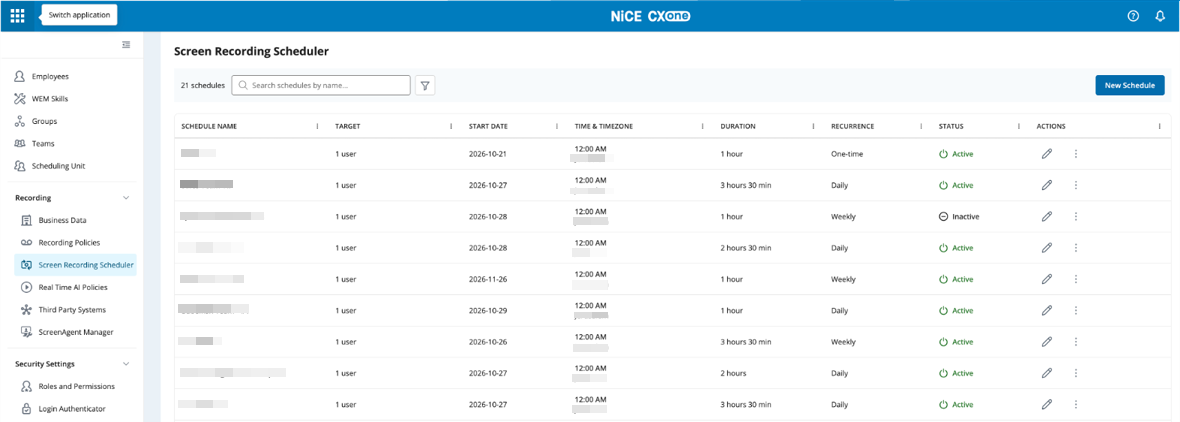
| Customer Request |
Yes |
UI Change |
Yes |
Availability | Preview
On deploy |
Playback Audit Events Improvements
Previously, when a reviewer closed the Player before playback finishes, the system did not capture an accurate audit record of that session. From this release, the Player now triggers a Playback Stopped audit event — including accurate playback duration and session details — whenever a reviewer exits early, keeping the compliance audit trail complete.
| Customer Request |
Yes |
UI Change |
No |
Availability | GA
On deploy |
Accessibility Improvements
Recording Policy Admin page includes significant accessibility improvements designed to offer a smoother, more inclusive experience for users across a wide range of visual, motor, and cognitive needs.
| Customer Request |
Yes |
UI Change |
Yes |
Availability | GA
On deploy |
Extended Search
A new Extended Search tab is introduced as a Public Preview in Interactions: Search and Playback. Extended Search offers more powerful capabilities: pre-Search granular filtering, column selectors, date pickers, Saved and Shared Queries, enhanced Business Data filtering, full interaction playback, and search result export. Extended Search is optimized for historical searches and enables users to search up to 21 years of interaction history, including ingested interactions and Migrated Calls interactions.
| Customer Request |
Yes |
UI Change |
Yes |
Availability | Preview
On toggle |
Reporting
Enhanced Filtering for Completed Contacts API
The Completed Contacts API supports filtering by contact The person interacting with an agent, IVR, or bot in your contact center. end date. Previously, this API only filtered records based on the contact start date. In this release, using the optional contactDateParadigm flag, you can filter results by the contact end date instead of relying solely on the contact start date. This enhancement provides more precise reporting and simplifies incremental data synchronization, especially in high-volume environments. Existing integrations remain unchanged because the flag defaults to the contact start date.
| Customer Request |
Yes |
UI Change |
No |
Availability | GA
On deploy |
Media Type Filtering for Contacts API
The Contacts API supports filtering by media type A medium, such as voice, email, and chat, through which a contact connects with an intended recipient.. Previously, this API returned a combined, aggregated result of voice and digital Any channel, contact, or skill associated with Digital Experience (DX). contact data in a single response. In this release, users can use the MediaTypeID parameter to retrieve data for a specific media type such as Call, Chat, Email, SMS, Digital, and so on in a single request. This enhancement improves data retrieval speed and API reliability by eliminating unnecessary large-scale data aggregation when only a single media type is required.
Existing integrations remain unchanged because omitting the parameter returns data for all media types.
| Customer Request |
Yes |
UI Change |
No |
Availability | GA
On deploy |
Enhanced Caller Identity Privacy for Completed-Contacts API
The Completed Contacts API strictly enforces the Hide caller phone number permission to ensure sensitive caller information remains protected.
When this permission is enabled, the API performs a real-time permission check and returns restricted instead of the ANI Also known as caller ID. Listed phone number of an incoming voice call. or phone number.
Existing behavior remains unchanged for users who do not have this permission enabled.
| Customer Request |
No |
UI Change |
No |
Availability | GA
On deploy |
Enhanced Filtering for Completed Contacts API
The Completed Contacts API supports media type A medium, such as voice, email, and chat, through which a contact connects with an intended recipient. filtering when tracking recent updates. This enhancement ensures that contact The person interacting with an agent, IVR, or bot in your contact center. data is accurately filtered and retrieved when tracking changes made since a specific timestamp. As a result, you receive more accurate results and avoid missing records when filtering by a specific media type.
Existing integrations remain unchanged because omitting the parameter returns data for all media types.
| Customer Request |
No |
UI Change |
No |
Availability | GA
On deploy |
Studio
Script Validation
When you save a script, Studio checks to see if the script contains an ONRELEASE action branch with an END action. If it does, Studio does not allow the script to be saved until the END action is removed. This is because END triggers the ONRELEASE branch, so having an END in the ONRELEASE branch causes problems in the system.
Customer action required: If you have scripts with ONRELEASE branches that have END, you need to remove it. You don't need a replacement for END because the script terminates automatically when there are no more actions in the ONRELEASE branch to execute.
| Web or Desktop Studio |
Web only |
Customer Request |
No |
UI Change |
No |
Availability | GA
On toggle |
Supervisor
Quick Link to Reports
You can quickly access the new Reports application in the Supervisor Workspace (Supervisor), alongside the existing Reporting link.
Access to Reports depends on your organization’s licenses and the permissions assigned to you.
| Customer Request |
Yes |
UI Change |
Yes |
Availability | GA
On deploy |
Supervisor State Restoration After Voice Monitoring
You automatically return to your previous state when you end a voice monitoring session, instead of remaining in Unavailable state.
This feature is available only to tenants High-level organizational grouping used to manage technical support, billing, and global settings for your NiCE CXone system. who explicitly enable the setting Revert to Original State Upon Voice Monitor End under Global Settings. The setting is turned off by default.
| Customer Request |
Yes |
UI Change |
Yes |
Availability | GA
On deploy On setting enablement |
Monitoring Notifications by Team and/or Group
Monitoring notifications to agents now let you target specific teams and/or groups of agents instead of notifying all agents in your organization. You can configure this on the Global Settings page individually for each monitoring action: Monitor, Screen Monitor, Assist, Join, Take Over, and Record. All changes to these settings are audited for monitoring purposes.
| Customer Request |
Yes |
UI Change |
Yes |
Availability | GA
On deploy |
Filter by Unavailable Breakdown States in Activity Log
You can filter the Activity log by individual Unavailable breakdown states to help you isolate specific use cases.
| Customer Request |
Yes |
UI Change |
Yes |
Availability | GA
On deploy |
Standardized Duration Format
All duration formats across Supervisor Workspace (Supervisor) including Live Monitoring views, activity panels, exports, and reporting cards are standardized to hh:mm:ss format for consistency.
| Customer Request |
Yes |
UI Change |
No |
Availability | GA
On deploy |
Test Suite
Test Suite Support for Combined Primary and Secondary KB Answers
Previously, Test Suite evaluated a single Knowledge Base (KB) Answer response mode based on your profile's configuration. If your profile was set to return a Primary answer, Test Suite returned the Primary response. If it was set to return a Secondary answer, Test Suite returned the Secondary response. If it was set to return both, Test Suite returned only the Primary response.
In this release, Test Suite detects when a profile is configured to return both a Primary and a Secondary answer together, and evaluates each one correctly. You can:
-
See a clear indicator of whether a KB Answer response is Primary, Secondary, or both, so you always know what you are reviewing.
-
See separate expected-response fields for the Primary and Secondary answers when your profile returns both. This lets you set up accurate test cases instead of using a single field that does not match your real configuration.
-
Get separate scores for the Primary and Secondary answers. Because they answer different questions, this keeps your results meaningful.
This feature will be available later in the release cycle.
| Customer Request |
No |
UI Change |
Yes |
Availability | GA
On deploy |
Unified Agent Workspace for Servicenow
These features will be available later in the release cycle.
ServiceNow Email Unified Interaction Routing
NiCE CXone has extended its unified routing integration with ServiceNow to support the digital Any channel, contact, or skill associated with Digital Experience (DX). email channel Various voice and digital communication mediums that facilitate customer interactions in a contact center.. Agents can initiate, receive, and manage inbound and outbound email interactions directly within their unified ServiceNow workspace alongside voice and chat. The integration automatically synchronizes agent availability, presence states, and cognitive workload in real time between ServiceNow and NiCE CXone, preventing multi-channel overload and maintaining consistent conversation context without switching platforms.
| Customer Request |
Yes |
UI Change |
Yes |
Availability | GA
On toggle |
ServiceNow Case Routing Through Work Items
NiCE CXone supports external case routing for ServiceNow through work items Customizable method of delivering contacts to an agent via Studio scripts.. This feature allow you to automatically route ServiceNow cases, incidents, and tasks directly to the most qualified agents using NiCE CXone skill Used to automate delivery of interactions based on agent skills, abilities, and knowledge.-based and priority routing rules. By centralizing queue management and delivering backend CRM Third-party systems that manage such things as contacts, sales information, support details, and case histories. tasks alongside real-time interactions directly in the agent workspace, you can improve first-contact resolution, balance agent workload, and streamline operational efficiency.
| Customer Request |
Yes |
UI Change |
Yes |
Availability | GA
On toggle |
Support for Agent-to-Agent Consult and Transfer in ServiceNow
Agents using Agent Workspace for ServiceNow can perform direct consults and transfers to specific agents, expanding beyond the existing queue-only transfer support. This enhancement streamlines agent-to-agent collaboration and consultation, enabling faster issue resolution and delivering a smoother interaction experience directly within ServiceNow.
| Customer Request |
No |
UI Change |
No |
Availability | GA
On toggle |
Role-Based Access Control Permissions for Unified Agent Workspace for ServiceNow
NiCE CXone supports dedicated Role-Based Access Control (RBAC) permissions for Unified Agent Workspace for ServiceNow for NiCE CXone roles. You can configure granular access rights for mapping web application configurations, including View, Create, Edit, and Delete permissions for Account Mapping, as well as Create, Edit, and Delete permissions for Channel Mapping and Presence Mapping. This enhancement ensures secure and tailored administration by allowing you to grant configuration privileges based on specific user roles and operational requirements.
| Customer Request |
No |
UI Change |
Yes |
Availability | GA
On toggle |
Automatic Version Number Updates in ServiceNow Managed Package
When you install or update the NICE CXone managed package in ServiceNow, version numbers across all applicable ServiceNow configuration areas now update automatically. This enhancement eliminates the need for you to manually edit version numbers after an upgrade, streamlining the deployment process and preventing configuration errors caused by missed manual steps.
| Customer Request | Yes | UI Change |
No |
Availability | GA
On toggle |
Voice Access
RCS and MMS Support
Users can now use RCS and MMS messaging capabilities across Europe, Asia, and South America. Expanded regional coverage helps improve messaging reliability, scalability, and secure communication workflows for broader customer engagement.
| Customer Request |
No |
UI Change |
Yes |
Availability | GA
On deploy |
Vonage Mobile Messaging Migration
SMS traffic is now migrated from the legacy NiCE CXone SMS system to Vonage Mobile Messaging, providing a more reliable and scalable messaging infrastructure. Users retain Point of Contact The entry point that an inbound contact uses to initiate an interaction, such as a phone number or email address. identity and conversation history, while simplified setup removes the need for transport code and SMS registration in ACD Contact Settings.
| Customer Request |
No |
UI Change |
Yes |
Availability | GA
On deploy |
Workforce Management (CXone)
Access NiCE CXone WFM Operational Data in Data Share
Starting with the 26.4 release, you can access operational Workforce Management (WFM) datasets directly in your Snowflake data warehouse through NiCE CXone Data Share. This capability allows you to query, blend, and analyze your workforce management data to create custom reports and business intelligence dashboards.
Previously, you could only access WFM data, such as schedule adherence, intraday metrics, and activity duration, through the WFM user interface and standard pre-built reports. To combine this data with external enterprise systems, you had to build custom API integrations or request custom report development.
In this release, you can:
-
Track schedule adherence: Query scheduled versus actual agent activities and evaluate interval-level adherence details.
-
Analyze intraday performance: Compare forecasted and actual intraday operational metrics (average handle time [AHT], service level agreement [SLA], and contact volume) at the skill group and interval levels.
-
Measure scheduled time utilization: Analyze the duration of scheduled activities mapped across activity codes and payroll classifications.
-
Map ACD events to WFM activities: Trace ACD agent states directly to WFM activity codes to correlate scheduled plans with actual agent behaviors.
-
Filter by core WFM dimensions: Query supporting dimensions, including scheduling units and payroll codes, to segment and contextualize your enterprise analytics.
Ask your NiCE CXone account representative to enable Data Share for your tenant High-level organizational grouping used to manage technical support, billing, and global settings for your NiCE CXone system. and have a Snowflake account ready (either your own or the account provided by NiCE CXone) before you run your first query.
| Customer Request |
No |
UI Change |
No |
Availability | GA
On deploy |
Improve Schedule Adherence with Automated Agent Reminders in My Zone
Note: This feature requires a WFM Advanced license.
You can receive automated reminders for upcoming scheduled activities directly in My Zone. These reminders help you keep track of upcoming activities, reduce missed or delayed activity starts, and maintain schedule adherence throughout your shift.
Previously, agents had to manually monitor their schedules in My Zone to keep track of upcoming activities. When handling customer interactions or working on offline tasks, agents could miss the start time of a scheduled activity, which could lead to schedule adherence variances and additional follow-up.
In this release, you get the following enhancements:
-
In-app: The system sends automatic reminders in the My Zone web application before a scheduled activity starts.
-
Configurable reminder timing: Administrators can define when reminders are sent before an activity begins. Available options include 5, 10, 15, 30 minutes.
-
Activity-based reminders: Administrators can select which activity codes, such as Break, Lunch, Meeting, or Training, trigger reminders by selecting Enable Reminder
-
Snooze and dismiss options: You can dismiss a reminder after acknowledging it or snooze it for 5, 10, or 15 minutes directly from the notification.
This enhancement helps ensure that agents are notified of upcoming activities at the right time, making it easier to follow schedules and transition between activities as planned.
| Customer Request |
Yes |
UI Change |
Yes |
Availability | GA
On toggle |
Track Schedule Adherence and Receive Out-of-Adherence Alerts in My Zone and Mobile
Note: This feature requires a WFM Premium license.
You can view your schedule adherence status and receive adherence alerts directly in My Zone and on your mobile device. These capabilities help you monitor your adherence throughout the day and identify schedule variances more quickly.
Previously, agents could not view their real-time adherence status or daily adherence details in My Zone or on mobile devices. Supervisors had to monitor adherence separately and notify agents when schedule variances occurred.
In this release, you have access to the following enhancements:
-
Adherence alerts: The system sends notifications in the My Zone web application and on mobile devices when an agent is out of adherence. The default threshold is one minute.
-
Daily adherence summary: You can view your daily adherence score, total time in adherence, and total time out of adherence directly in My Zone.
This enhancement provides greater visibility into your schedule adherence and helps you identify and address adherence variances throughout the day.
| Customer Request |
Yes |
UI Change |
Yes |
Availability | GA
On toggle |
Flexible Time Off Planning with Configurable Custom Groups
Configurable Custom Groups help you manage time-off more effectively by organizing agents based on shift start, skills, or employment types. Grouping agents into dedicated Custom Groups helps you balance time-off availability across various agent groups, reducing the need for manual adjustments and ensuring you are staffed appropriately.
Previously, time-off rules, allowances, and approval workflows were tied to scheduling units. Agents within the same scheduling unit could not be grouped separately for time-off management, which could make it difficult to balance leave availability across the entire day, leading to an excessive number of time-off requests being approved during a particular time of day.
In this release, the following enhancements are available:
-
Custom Groups: You can create and manage Custom Groups to organize agents based on shift patterns, employment type, skills, or other operational needs.
-
Agent assignment options: You can assign agents individually or in bulk to a Custom Group.
-
Time-off configuration integration: You can select Custom Groups when configuring Time Off Rules, Approval Rules, and Time Off Summary settings.
-
Custom Group visibility: The Agent Configuration table includes a view-only column that displays each agent's assigned Custom Group.
This enhancement provides more flexible time-off management and helps you apply time-off policies to specific groups of agents without relying solely on scheduling unit structures.
Note: All customers are migrated to the Custom Groups configuration, with Custom Groups automatically generated to match their existing scheduling units. No immediate action is required.
| Customer Request |
Yes |
UI Change |
Yes |
Availability | GA
On toggle |
Manage Time-Off Allowances by Specific Calendar Dates
You can define different time-off allowances for specific calendar dates to accommodate staffing changes during holidays, the days leading up to or following a holiday, blackout periods, and major business events such as marketing campaigns or new-hire onboarding.
Previously, time-off limits in Time Off Approval Rules were restricted to static single values or recurring day-of-week patterns. You could not customize allowances for specific dates, configure explicit blackout dates without creating workaround rules, or compare allotted time against scheduled and taken time off in a unified view.
In this release, a new Time Off Allowance page lets you manage time-off caps across an entire year using a centralized, interactive grid. This includes setting date-specific allowances, establishing blackout periods with zero capacity, and applying bulk adjustments across date ranges.
Date-range and day-of-week bulk filling: You apply adjustments across custom date ranges and target specific days of the week, such as every Friday or weekend.
The Time Off Allowance page also provides unified balance tracking, showing allotted, scheduled, taken, and remaining time off in hours and minutes format.
Note: All customers who use scheduling unit balances defined in time-off Approval Rules will be migrated to the Time Off Allowance functionality. After release 26.4, review your date-specific allowances and adjust them as needed to meet your business needs.
| Customer Request |
Yes |
UI Change |
Yes |
Availability | GA
On toggle |
Filter Future Activities by Activity Code and Date Range
When managing upcoming schedules and predefined events in Schedule Manager, dedicated filters in the Future Activities panel let you quickly locate specific activities. You can find single or recurring events without scrolling through large volumes of schedule data.
Previously, the Future Activities panel only provided column sorting. When managing hundreds of recurring or single-occurrence events, or when working across many employees and Scheduling Units, you had to manually scroll through the entire list to find, review, or edit specific activities.
In this release, the following changes apply:
-
Activity code filtering: You can filter the list using a multi-select dropdown populated with all activity codes currently configured for future activities.
-
Date range filtering: You can select a start and end date to display single and recurring events that overlap with the selected time period.
-
Filter stacking and reset: You can apply both filters simultaneously, view an updated result count in real time, and reset your selections using a single Clear Filters option.
This enhancement helps you find and manage future activities more efficiently, especially when working with large numbers of scheduled events.
| Customer Request |
No |
UI Change |
Yes |
Availability | Preview
On toggle |
Align Forecast Volume and Average Handle Time Between Step 3 and Step 5
You can view consistent Forecast Volume and Average Handle Time (AHT) metrics across both Generate forecast (Step 3) and Generate staffing (Step 5) in the WFM Forecasting workflow. This alignment ensures metric parity across calculation and staffing views, providing accurate data continuity throughout your workforce planning process.
Previously, Step 3 displayed unrounded calculated values for forecast volume and AHT, whereas Step 5 displayed these metrics as rounded whole numbers. This rounding variance created apparent numerical differences between the two steps for the same skill and interval, making it difficult to verify data integrity between the forecast and staffing stages.
In this release, rounding is removed from the Forecast Volume and Forecast AHT displayed in Step 5. Step 5 displays the unrounded values from Step 3, ensuring complete interval-level and daily data reconciliation between both steps.
These unrounded values also carry over to downstream modules and reports, including Intraday Manager, Intraday Reports, and Schedule Manager.
Simulated Volume and Simulated AHT continue to display as rounded whole numbers to support discrete staffing simulations.
| Customer Request |
Yes |
UI Change |
Yes |
Availability | GA
On deploy |
Accessibility Improvements
WFM includes significant accessibility improvements designed to offer a smoother, more inclusive experience for users across a wide range of visual, motor, and cognitive needs.
These improvements include updates across multiple areas of the application. For example, the Schedule Optimization Plans and Schedule Optimization Rules page feature refreshed icons, accessible labeling, improved keyboard navigation, and full screen reader support (such as JAWS) in compliance with WCAG 2.1 Level AA standards. These are appearance and usability enhancements only; all existing functionalities remain unchanged.
| Customer Request |
No |
UI Change |
Yes |
Availability | GA
On toggle |
Shift Length Ending in One-Minute Increments
Note: This feature requires a WFM Advanced License.
You can configure daily shift lengths with end times in one-minute increments while keeping all other scheduled activities aligned to standard 15-minute intervals. This flexibility helps you support work schedules that don't fit evenly into 15-minute blocks, such as 38-hour workweeks (7 hours and 36 minutes per day) and region-specific labor requirements.
Previously, daily rule shift lengths were limited to 15-minute increments. As a result, if your organization used non-standard workweeks, such as 36-hour or 38-hour schedules, you needed to manually adjust generated schedules to meet exact shift-length requirements.
In this release, you can enter an exact shift end time in the Daily Rules configuration. During schedule generation, CXone WFM continues to create schedule activities in standard 15-minute intervals while enforcing the specified shift end time as a hard constraint.
Generated schedules display the exact shift end time across Schedule Manager views and grids. Net Staffing calculations also account for partial interval minutes, helping you maintain accurate staffing coverage and schedule totals.
| Customer Request |
No |
UI Change |
Yes |
Availability | GA
On toggle |
Accurate and SLA-Driven Staffing Requirements for Real-Time Skills
With the 26.4 release, WFM introduces enhanced staffing calculations for real-time skills in True to Interval (TTI) forecasts in Generate staffing (Step 5) of the WFM Forecasting wizard. This enhancement enables workforce planners to generate SLA-sensitive staffing requirements that reflect configured Service Level (SL) and Average Speed of Answer (ASA) targets, helping reduce overstaffing and artificial headcount fluctuations across intervals.
Previously, staffing calculations could allow contact volume from one interval to artificially inflate staffing numbers in subsequent intervals. In addition, calculations could continue adding headcount even after target service levels had been met. These factors could result in higher-than-expected staffing numbers that remained largely unchanged even when service level targets were adjusted.
In this release, the staffing calculation engine accounts for workload across intervals and your configured performance targets:
-
Target-based staffing sizing: Headcount calculations stop as soon as configured service-level and ASA targets are met.
-
Workload-based staffing distribution: The staffing simulation uses received contact volume and contact AHT to calculate staffing requirements. It distributes handling time across intervals and accounts for active contacts that continue into subsequent intervals when determining agent availability and staffing distribution.
-
Dynamic SLA responsiveness: Headcount recommendations dynamically adjust when you change service level parameters.
-
Updated staffing parameters: For real-time skills, you must select a Service Level target, a Wait Time (ASA) target, or both in Staffing Parameters (Step 4) to continue. Maximum Occupancy is optional and acts as an upper limit on agent occupancy. It can no longer be the only configured staffing parameter.
These improvements help produce leaner, more predictable headcount requirements across Generate staffing (Step 5), Schedule Manager, and Intraday Manager.
This enhancement applies only to real-time skills in TTI forecasts. Staffing calculations for deferrable workloads and imported forecast or historical data remain unchanged. For existing forecast jobs, select a service level or ASA target in Step 4 and regenerate staffing to apply the updated calculation.
| Customer Request |
Yes |
UI Change |
No |
Availability | GA
On toggle |
Machine Learning Forecasting Model for Advanced and Premium Tiers
In release 26.4, you can use new machine learning (ML) forecasting models, Prophet, LightGBM, and TimesFM, in the Generate forecast (Step 3) workflow, depending on your license tier.
By leveraging these models, you capture complex demand patterns, irregular trends, and non-linear relationships across historical data to produce more accurate forecasts and optimized staffing plans.
Previously, when generating a forecast, you relied on traditional statistical algorithms to project future contact volumes and handle times. While effective for standard call patterns, these models might not have fully captured complex seasonal variations or multi-variable trends across intricate contact center interaction data.
In this release, you will see the following capabilities when creating forecasts for eligible skills:
-
Tiered model access: Prophet is available to Advanced and Premium tier customers; LightGBM and TimesFM are available to Premium tier customers only.
-
Model training and execution: LightGBM trains in the background to adapt to recent contact patterns. Prophet analyzes historical data when a forecast job runs. TimesFM uses a pretrained model and requires no additional training.
-
Dynamic method availability: You see the new ML forecasting model in the Method dropdown for any skill that has an actively trained model available.
-
Best Pick evaluation: When you select Best Pick, the system automatically evaluates the ML model alongside traditional statistical methods and selects it whenever it delivers the highest forecast accuracy for your skill.
| Customer Request |
Yes |
UI Change |
Yes |
Availability | GA
On deploy |
Bulk Quick Edits for Time-Off Allowance Adjustments
Note: This feature requires a WFM Advanced license.
Managing daily time-off allotments is faster and more efficient with the introduction of Quick Edit tools in Time Off Allowance Management. You can update existing defined allowances beyond a flat value, either adding or subtracting a value or adding or subtracting a percentage, eliminating the need to modify individual dates during holidays or seasonal surges.
In this release, you manage allowances using the following bulk-editing enhancements:
-
Adding or Subtracting adjustments: Adjustments support flat increases and decreases (+/- values).
-
Percentage adjustments: Adjustments support percentage changes (+/- %).
-
Built-in blackout safeguards: System validations prevent values from dropping below zero. In addition, percentage changes do not alter zero allotments (blackout dates), and flat adjustments on zero values require confirmation before overriding.
| Customer Request |
No |
UI Change |
Yes |
Availability | GA
On toggle |
Integrate Cisco UCCE with NiCE CXone WFM
With the 26.4 release, you can integrate Cisco Unified Contact Center Enterprise (UCCE) with WFM. This integration enables you to stream real-time agent states and historical contact center data from your Cisco UCCE environment into WFM, helping you manage forecasting, scheduling, intraday operations, and real-time adherence from a single workforce management solution.
Previously, if you used Cisco UCCE as your automatic call distributor (ACD), connecting to WFM might have required custom integrations or manual data imports to provide workload and agent activity data for workforce management.
In this release, you can:
-
Capture workload data for voice, email, and chat interactions.
-
Use historical contact volume, handle time, and queue data for forecasting and scheduling.
-
Track live agent status updates in Real-Time Adherence (RTA) and Intraday Manager.
-
Monitor intraday performance throughout the day and make staffing adjustments as needed.
| Customer Request |
Yes |
UI Change |
No |
Availability | GA
On deploy |
Release Adjustments
The Release Adjustments section describes the changes, removals, and additions made in the feature descriptions since the initial coming soon announcement for the 26.3 release.
Changed Features
This section describes changes that have been made to feature descriptions since the initial coming soon announcement. Each item includes a description of the feature as it was previously published on the Coming Soon page and an explanation of what changed.
Outbound Engagement (SmartReach)
Reporting Integration
It was previously announced that this feature would be available by a toggle. However, it will be available on deploy.
Accessibility Support for WCAG 2.2 (Phase 2)
It was previously announced that this feature was a customer request. However, it was not a customer request.
Enhanced Speed-to-Lead API
It was previously announced that this feature was a customer request. However, it was not a customer request.
Recording Management (CXone)
Screen Recording Scheduler for Front Office and Back Office
It was previously announced that this feature will be generally available. However, this feature is available for public preview only in this release.
Features Removed from This Release
This section describes product changes that were included in the initial coming soon announcement and have since been removed from this release. These will not be part of the 26.3 release but may be part of a future release.
ACD
Removed Feature: Primary Skills Page in Routing Center
You will be able to view a Primary Skills page in Routing Center, listing every skill and the percentage of agents who have it set as their primary ACD skill, with an exact agent count shown on hover.
Removed Feature: Bulk Upload and Download for Primary Skill Assignments in Routing Center
You will be able to manage primary skill assignments at scale in the Routing Center.
Agent Workspace (Agent)
Removed Feature: Immediate Backend Instantiation for Digital Manual Outbound Drafts
New manual outbound draft messages for digital channels will soon be fully instantiated on the backend platform as soon as they are created, rather than waiting until the first message is sent. This update will ensure that draft messages are immediately associated with Contact and Interaction IDs, allowing agents with active drafts to correctly appear in a Working state when Unified Agent State is enabled.
Removed Feature: Display of Orphan Messages in Social Channels
Agent Workspace (Agent) will soon ensure that all messages in a public social digital thread are visible, even if they are missing hierarchical linking data. This update will prevent "orphan" messages from being dropped, providing agents with a complete and accurate history of every contact interaction.
Analytics services
Removed Feature: Enhanced Accuracy and Coverage in Topic AI
Topic AI will provide even greater coverage and accuracy by integrating Large Language Model (LLM) technology into the inference process. This update will allow the system to more precisely identify the correct intent or action for each interaction, resulting in an 8% to 10% improvement in both accuracy and coverage. These enhancements will ensure more reliable data for downstream analytics and provide a more comprehensive view of customer conversations.
Removed Feature: Analytics Policies & Pipeline Enhancements
- Improved Transcript Accuracy: The analytics pipeline removes duplicate punctuation by eliminating a redundant ingest step. It also relies exclusively on the V11 transcription engine to improve accuracy and resolve formatting inconsistencies.
-
UI Label Update: The Quality Management Analytics checkbox in the Policy Scope section is renamed to Quality Management Advanced.
Dashboards
Removed Feature: Contact List Widget Enhancements
The Contact List widget will display all active contacts, even in high-volume environments, providing a more complete view of contact activity.
Removed Feature: Updated Agent Contact Performance History Report
The Agent Contact Performance and History Report will include a new Disposition Details widget that will show contact disposition information, including descriptions, classifications, and notes.
Removed Feature: Intraweek Support
Dashboards will load the last seven days of data up to 10 times faster using a pre-calculated cache that refreshes every 15–30 minutes.
Desktop Discovery
Removed Feature: On-Demand Log Collection
You will soon be able to manually trigger log collection for specific clients directly from the Node Watch. This feature will allow you to request a snapshot of system logs at any time and view or download the resulting files within the application for faster troubleshooting.
Removed Feature: FedRAMP Compliance Enhancements
Desktop Discovery will soon include security and infrastructure enhancements designed to support compliance with FedRAMP Moderate (NIST SP 800-53 Rev. 5) standards.
Removed Feature: Process Intelligence Reports
Operational Managers will soon be able to create, submit, and track Process Intelligence reports directly from the Reports screen. A streamlined, validated form with intuitive team and skill selection will help ensure report requests are uniquely named and within supported date ranges, while a centralized, auto-updating Reports Grid will provide real-time visibility into report status from submission through completion.
Removed Feature: Configurable Application Collection and Preprocessing Policies
Administrators will soon have granular control over data collection and preprocessing for specific applications using new block-list and allow-list capabilities. This feature will allow for the suppression of duplicate data in remote-session environments like Citrix and enable application-specific data sanitization to meet precise compliance requirements.
Interaction Analytics (CXone)
Support for Date Values in Category Rules
Interaction Analytics (CXone) will soon allow you to use date values from your Business Data when defining category rules. This enhancement will enable more precise categorization by allowing the system to evaluate specific date-based criteria within your interaction data.
Outbound Engagement (SmartReach)
Removed Feature: International Dialing Profile Expansion
The Dialing Profile internationalization expansion will be expanded to Australia, the UK, and India to enable full functionality within the Dialing Profile editor.
Performance Management (Native)
Removed Feature: Support for Non-ACD Tenants
Performance Management (Native) will support tenants that do not use ACD, allowing them to create objectives, metrics, games, and wallboards without ACD-specific settings or requirements.
Recording Management (CXone)
Removed Feature: New Permissions for Voice Transcripts and IA Categories in Player
Two new role-level permissions lets admins control Player visibility of voice transcripts and IA categories, gated by an Interaction Analytics (CXone) license. Permissions default to on, so existing access does not change unless restricted.
Features Added to This Release
This section notes product changes that have been added to this release since the initial coming soon announcement. To see the following features in detail, select the product in the filter on the right.
Desktop Discovery
Desktop Discovery Client System Tray and Off-Desktop Controls
Digital Experience (DX)
Contact Acceleration Job and Condition for Workflow Automation
Feedback Management
Speech-to-text engine version upgrade
Interaction Analytics (CXone)
Support for New Operators in Metrics Category Rules
Copilot for Analytics Accessibility Support
Outbound Engagement (SmartReach)
Interactions: Expanded Rich Message Support for Digital Channels
Segment Support for Contact Export Jobs