

This help page is for Desktop Studio. This information is also available for Studio.
|
|
Solicita un agente con una ACD habilidad Si un agente está disponible de inmediato, el contacto se enruta a ese agente. Si el agente no está disponible, el contacto se coloca en cola. Se activa el OnAnswer event cuando un agente comienza la interacción con el contacto. Reqagent Es el punto del script donde el contacto pasa del estado de Precola al estado de En cola. Cuando un contacto está en cola, puede definir una secuencia de acciones que se produce mientras el contacto espera a que lo atienda un agente. También puede definir la lógica para gestionar escenarios tales como cuando el contacto ha esperado una cantidad de tiempo determinada. La sección Consejos y trucos contiene ejemplos de qué cosas puede incluir en un patrón de espera. If you want to adjust the proficiency required in the specified skill based on the length of time the contact stays in the queue, add the UpdateContact action to your script. Typically, a Music action would be placed between Reqagent and UpdateContact. |

Tipos de scripts compatibles
|
|
|
|
|
|
|
|
|
Generic |
Chat | Phone | Voicemail | Work Item | SMS |


Reqagent también se puede utilizar con scripts de tipos de soporte de medios digitales Cualquier canal, contacto o habilidad asociado con Digital Experience (DX)., pero tiene una página de ayuda aparte.
Propiedades de entrada
Estas propiedades definen los datos que utiliza la acción al ejecutarse.
Puede usar la sustitución de variables en todas las propiedades de esta acción.
|
Las propiedad |
Descripción |
|---|---|
| Caption |
Cambie Caption por algo que identifique de forma única esta acción en el script. El informe de Ruta de Pulsado del IVR incluye el nombre de la acción y el título. Los subtítulos únicos y descriptivos hacen que los informes sean más fáciles de leer y comprender. |
| Habilidad | Seleccione la ACD habilidad Se usa para automatizar la entrega de interacciones según las habilidades, capacidades y conocimientos del agente. a la que desea que se dirijan los contactos. Si selecciona Default, el script utiliza la habilidad predeterminada asignada al punto de contacto punto de entrada que utiliza un contacto entrante para iniciar una interacción, como un número de teléfono o una dirección de correo electrónico. asociado. Con esta propiedad es habitual usar sustitución de variables. |
| TargetAgent |
Allows you to specify an agent to handle contacts routed by Skill you specified. For example, if you have an agent who is an expert in one niche field, you could set their name to take the contact when an agent is requested. Select an agent from the drop-down or begin typing a name to find the agent. You can use a variable in this field. For example, {agentId}. If the target agent is unavailable or refuses the call, NiCE CXone queues the contact until the target agent becomes available. |
| PriorityManagement |
Allows you to specify how you want priority management handled for this action. The default is DefaultFromSkill. This means the script uses the priority management defined in the Skill you selected. Select Custom if you want to override the priority settings for the skill and specify different handling. Set the levels you want this action to use in the InitialPriority, Acceleration, and MaxPriority fields. |
| InitialPriority |
Especifique la prioridad base del contacto a medida que ingresa al sistema. La prioridad |
| Acceleration |
Determines how quickly the priority increases with every minute the contact stays in queue. The default value is 1. The minimum value is 0 and the maximum priority is the value configured in the Max Priority property. For example, if the Initial Priority is 4 and you set Acceleration to 1, then with each passing minute that the contact is not handled, the priority increases by one. If the contact is still in queue after three minutes, the priority will be raised to 7. You can set InitialPriority for one skill lower than for another skill, but if you set Acceleration for that skill higher, it can jump spots in the queue. For example, you set Skill A's InitialPriority to 1 and Acceleration to 5. You set Skill B's InitialPriority to 3 and Acceleration to 1. Initially, a contact for Skill B will be first in queue because it has a priority of 3, but after one minute, a contact for Skill A will take its place at the top because its priority will be 6. NiCE CXone combines the acceleration value with the time the interaction has been in queue and the initial priority using the formula Overall Priority = (Time * Acceleration) + Initial Priority. |
| MaxPriority |
Specify the maximum priority that a contact using this skill can have. If a contact reaches max priority, priority is the only factor NiCE CXone uses to route the contact. This can cause issues if multiple contacts all reach max priority at the same time. |
| Sequence |
Le permite personalizar la señal de audio que se les da a los agentes cuando tienen un nuevo contacto Si desea utilizar sólo un archivo de audio, ingrese el nombre y la ruta del archivo entre comillas dobles. Por ejemplo, "nuevoContacto.wav". If you want to create a more complex notification, you can use the Sequence Editor in the Play action. When the prompt is finished, copy the contents from the Sequence property in the Play action into the Sequence property in this action. Si no especifica un archivo de audio en esta propiedad, REQAGENT utiliza el tono zip predeterminado. Si no desea una señal de audio, configure Zip Tone en No ZipTone. |
| ZipTone |
Seleccione cuándo desea que se reproduzca el tono zip para alertar al agente de un nuevo contacto. Las opciones son:
El valor predeterminado es No Zip Tone. Esta propiedad reemplaza la action Ziptone. |
| ScreenPopSource |
Seleccione la fuente para pantalla emergente información. Complete este campo solo si desea incorporar pantallas emergentes en esta acción. Las opciones son:
|
| ScreenPopURL |
Specify the URL you want opened for the agent as a screen pop. You can use a variable in this property. The URL must be complete, including the http://. For example, http://www.yourdomainhere.com. You can append additional information to the end of the URL using variables from Assign actions earlier in the script. The ScreenPop property of the Assign action must be set to True for each variable you want to append to the URL. You also need to modify the ScreenPopURL to include the variables as parameters. Use this format: http://www.yourdomainhere.com?var1=value1&var2=value2 You can customize the title of the tab that pops up in the MAX interface by appending the icAgentPanelTitle= parameter to the URL. The URL specified in this property opens in the default browser. The screen pop appears for the agent when the ACD decides to route the contact to that agent and changes the contact's state to Routing. If you want screen pops to appear at a different time during an interaction, you can use the Runapp action. |
| HighProficiency |
La habilidad más alta que un agente debe tener para recibir un contacto. Los valores de competencia son números enteros del 1 al 20, siendo 1 el mejor y 20 el peor. |
|
LowProficiency |
La competencia de habilidad más baja que un agente debe tener para recibir un contacto. Los valores de competencia son números enteros del 1 al 20, siendo 1 el mejor y 20 el peor. |
| RoutingAttribute |
Select the specific attributes to use in the routing criteria. When requesting agents, only agents with the specified Skill and RoutingAttribute combination are matched. When used for routing decisions, you can use the UpdateContact action to change or remove the routing attributes later in the script. The default option is Not Applicable. You can use a variable for this property. You can enter more than one attribute by separating them with commas. Si limita demasiado su grupo de agentes, podrían quedarse atascadas en la cola sus interacciones sin agentes coincidentes a quienes enrutar. Para evitar esto, use no más de cinco atributos por acción de enrutamiento. Si no hay varios atributos habilitados y selecciona más de uno, el script solo busca agentes con el primer atributo enumerado. Cuando se habilitan varios atributos, busca agentes que tengan todos los atributos enumerados. |
Condiciones de la rama de resultados
Las condiciones de las ramas de resultados le permiten crear ramas en su script para manejar diferentes resultados cuando se ejecute una acción.
|
Condición |
Descripción |
|---|---|
|
Default |
La ruta tomada a menos que la secuencia de comandos cumpla una condición que requiera que tome una de las otras ramas. También se toma si las otras ramas no están definidas. |
| OnError |
La ruta tomada cuando la acción no se ejecuta correctamente. Por ejemplo, cuando hay un problema imprevisto, como una mala conectividad de Caso de uso específico: una segunda acción Reqagent en los intentos del script por cambiar la habilidad del contacto. Si el contacto está enrutando activamente hacia un agente cuando se intenta el cambio de habilidad, va hacia la rama OnError. |
Consejos y trucos
-
You can place actions after Reqagent to create a holding pattern. Common things to include in a holding pattern are:
-
Playing prompts and music.
-
Providing the current queue count.
-
Providing the current estimated wait time.
-
Offering the option of leaving a voicemail.
-
Performing a blind transfer after a certain amount of time.
-
Changing skill proficiency and other settings to increase the pool of available agents the longer the contact waits.
-
Fallback logic.
-
- As soon as the contact is in the Routing state, the __agentID variable is present in the script.
- This action adds a large number of pre-defined variables to the script. You can do a trace on the script to see what variables are present. If you have previously added these variables to your script, they are overwritten when the script gets to Reqagent.
- You can use bullseye routing to dynamically increase or decrease the pool of available agents. To do so, establish skill proficiency, a routing attribute, or both in the Reqagent action. Then use an UpdateContact action to change those values when specific criteria are met.
- Si usa Workforce Management (IEX Integrated), revise las Reglas de distribución Guide.
- Si usa Workforce Management (CXone), revise la ayuda en línea.
Si usa WFM, revise la documentación de su producto WFM antes de configurar el enrutamiento selecto. Determine las prácticas recomendadas y los posibles impactos en el pronóstico de usar el enrutamiento selecto con rangos de competencia, atributos de enrutamiento, o ambos.
Ejemplo de secuencia de comandos
Este es un ejemplo para demostrar cómo se puede utilizar esta acción en los scripts. No pretende ser un script completo. Es posible que se requiera programación adicional.
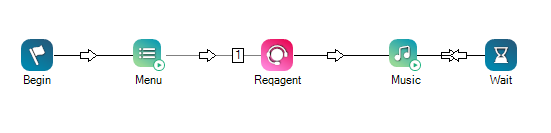
En este ejemplo, Begin desencadena un Menu, que utiliza texto artificial para decirle al interlocutor que pulse 1 para hablar con un agente del centro de atención telefónica. Si un agente no está disponible de inmediato, un bucle reproduce música durante 30 segundos, espera cinco segundos y se repite hasta que un agente responde la llamada.
¿Desea descargar este script?