
This help page is for Desktop Studio. This information is also available for Studio.
|
|
Solicita un agente que tenga una habilidad
You can also modify a digital contact's priority using the UPDATE CONTACT (DIGITAL) action. |

Dependencias
- Before working with digital scripts, learn more about the differences in how NiCE CXone handles digital and traditional ACD interactions.
- You must assign the script to the digital
 Cualquier canal, contacto o habilidad asociado con Digital Experience (DX). point of contact.
- In digital scripts, the Reqagent (Digital) action routes contacts to Digital Experience (DX). Digital Experience (DX) handles the contacts from that point, unless a workflow automation job spawns a script.
- Target agent, routing attributes, and priority require that your system uses dynamic delivery.
Tipos de Script admitidos
|
|
|
|

La acción Reqagent utilizada con todos los demás tipos de medio de script tiene una página de ayuda independiente.
Propiedades de Entrada
Todas las propiedades de esta acción admiten la sustitución de variables. Para ello, introduzca la variable en el campo de propiedad. Encierre la variable entre llaves ( { } ).
| Propiedad | Detalles |
|---|---|
| Título |
Ingrese una frase corta que identifique de forma única esta acción en el script. La leyenda aparece en el lienzo del script debajo del ícono de acción. |
| Habilidad |
Select the digital skill Se usa para automatizar la entrega de interacciones según las habilidades, capacidades y conocimientos del agente. (routing queue Determina a qué agentes enrutar los casos digitales, utilizando criterios como que el agente tenga experiencia en ese tipo de caso.) you want contacts routed to. If you select Default, the script uses the default skill assigned to the associated point of contact punto de entrada que utiliza un contacto entrante para iniciar una interacción, como un número de teléfono o una dirección de correo electrónico..
Con esta propiedad es habitual usar sustitución de variables. |
| Prioridad |
Enter the priority of contacts for this skill (0-1000). |
| HighProficiency |
La habilidad más alta que un agente debe tener para recibir un contacto. Los valores de competencia son números enteros del 1 al 20, siendo 1 el mejor y 20 el peor. |
|
LowProficiency |
La competencia de habilidad más baja que un agente debe tener para recibir un contacto. Los valores de competencia son números enteros del 1 al 20, siendo 1 el mejor y 20 el peor. |
| TargetAgent |
Allows you to specify an agent to handle contacts routed by Skill you specified. For example, if you have an agent who is an expert in one niche field, you could set their name to take the contact when an agent is requested. Select an agent from the drop-down or begin typing a name to find the agent. You can use a variable in this field. For example, {agentId}. If the target agent is unavailable or refuses the call, NiCE CXone queues the contact until the target agent becomes available. |
| RoutingAttribute |
Select the specific attributes to use in the routing criteria. When requesting agents, only agents with the specified Skill and RoutingAttribute combination are matched. When used for routing decisions, you can use the UpdateContact action to change or remove the routing attributes later in the script. The default option is Not Applicable. You can use a variable for this property. You can enter more than one attribute by separating them with commas. Si limita demasiado su grupo de agentes, podrían quedarse atascadas en la cola sus interacciones sin agentes coincidentes a quienes enrutar. Para evitar esto, use no más de cinco atributos por acción de enrutamiento. |
| Gestión de prioridad |
Allows you to specify how you want priority management handled for this action. The default is DefaultFromSkill. This means the script uses the priority management defined in the Skill you selected. Select Custom if you want to override the priority settings for the skill and specify different handling. Set the levels you want this action to use in the InitialPriority, Acceleration, and MaxPriority fields. |
| Aceleración |
Determines how quickly the priority increases with every minute the contact stays in queue. The default value is 1. The minimum value is 0 and the maximum priority is the value configured in the Max Priority property. For example, if the Initial Priority is 4 and you set Acceleration to 1, then with each passing minute that the contact is not handled, the priority increases by one. If the contact is still in queue after three minutes, the priority will be raised to 7. You can set InitialPriority for one skill lower than for another skill, but if you set Acceleration for that skill higher, it can jump spots in the queue. For example, you set Skill A's InitialPriority to 1 and Acceleration to 5. You set Skill B's InitialPriority to 3 and Acceleration to 1. Initially, a contact for Skill B will be first in queue because it has a priority of 3, but after one minute, a contact for Skill A will take its place at the top because its priority will be 6. NiCE CXone combines the acceleration value with the time the interaction has been in queue and the initial priority using the formula Overall Priority = (Time * Acceleration) + Initial Priority. |
| Prioridad máx. |
Specify the maximum priority that a contact using this skill can have. If a contact reaches max priority, priority is the only factor NiCE CXone uses to route the contact. This can cause issues if multiple contacts all reach max priority at the same time. Para los contactos Digital, la prioridad máxima es 1000. Esta puede ser diferente de la Prioridad máx. de otros tipos de contacto. |
Condiciones de rama de Resultado
Las condiciones de las ramas de resultados le permiten crear ramas en su script para manejar diferentes resultados cuando se ejecute una acción.
|
Condición |
Descripción |
|---|---|
|
Default |
Recorrido a menos que el script cumple una condición que requiere uno de los otros poderes. También se considera si no están definidas las demás ramas de la acción. |
|
OnError |
Ruta tomada cuando la acción no se ejecuta correctamente. Por ejemplo, cuando haya un problema inesperado como una mala conectividad, errores de sintaxis, etc. La variable _ERR, con un único carácter de subrayado, debe llenarse con una explicación condensada del problema. |
Ejemplo de Script
Este es un ejemplo para demostrar cómo se puede utilizar esta acción en los scripts. No pretende ser un script completo. Es posible que se requiera programación adicional.
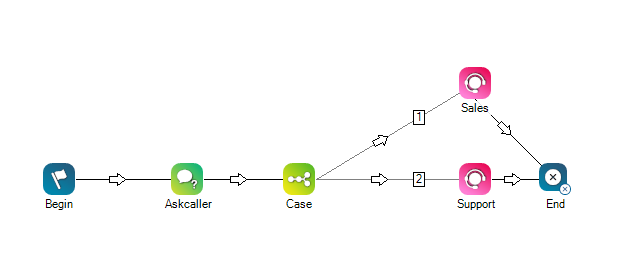
En este ejemplo, Begin activa una acción Askcaller, que le da al contacto la opción de comunicarse con ventas o con soporte. La acción Case crea dos ramas personalizadas, cada una de las cuales se conecta a una acción Reqagent digital. La rama 1 está configurada con la habilidad Se usa para automatizar la entrega de interacciones según las habilidades, capacidades y conocimientos del agente. para el equipo de Ventas y la rama 2 está configurada con la habilidad para el equipo de Soporte.
La última acción en este ejemplo es FINALIZAR. En los scripts digitales, la acción FINALIZAR finaliza el script, pero no el contacto. Después de la acción Reqagent, el contacto se transfiere a Digital Experience (DX), donde permanece hasta el final de la interacción, a menos que un trabajo de automatización de flujo de trabajo llame a otro script.