

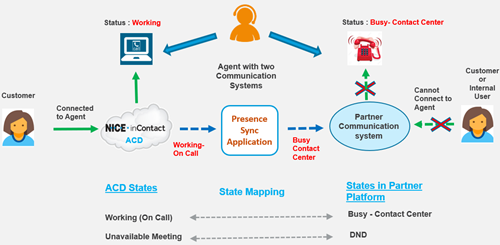
The Presence Sync application lets you sync agent states The availability status of an agent. between the NiCE CXone ACD and partner platforms. This ensures both systems are up to date on what the agent's state actually is. For example, if the agent is handling a call in NiCE CXone and their state is Busy, their status in Microsoft Teams would also be Busy. The sync would ensure the agent doesn't receive a call in Teams while they're handling the call in NiCE CXone.
Key facts about Presence Sync:
-
Presence Sync supports the Voice channel only.
-
You can only use one type of Presence Sync at a time. For example, you cannot sync NiCE CXone statuses with both Microsoft Teams and RingCentral.
-
Presence rules dictate which agent states are mapped between NiCE CXone and the other platform. You apply the presence rule to either teams or individual users.
-
In NiCE CXone, agent states are unavailable codes. You must apply these codes to teams. Then, agents on the team can change their state to those unavailable states.
If your agents use either MAX or a NiCE CXone Agent Workspace (Agent) application, Presence Sync does not work when agents call other agents or skills Used to automate delivery of interactions based on agent skills, abilities, and knowledge.. These types of interactions do not trigger a Presence Sync rule.
Types of Presence Rules
Presence rules let you link agent states between NiCE CXone and your external application. These rules determine what happens in either system when an agent's state changes. You can create three types of rules:
-
Publisher: When the NiCE CXone agent state changes, the external application then changes the agent's status to match the change. With this rule type, NiCE CXone tells the external platform what the status should change to.
-
Subscriber: The opposite of the publisher rule. This is when the agent state changes on the external platform, NiCE CXone waits for this to happen and changes the agent's status to match the change. With this rule type, the external platform tells NiCE CXone what the status should change to.
-
Bi-Directional: A combination of the previous two rules. When either agent state changes on either platform, the second platform also changes the agent's state to match the other system.
For example, if you want the Busy state in NiCE CXone to be connected with the Busy status in Salesforce, you would create a rule linking these two states together. You could create either a publisher rule or a bi-directional rule in this example.
Presence Sync Health Check and Log Reader
The Health Check tab in Presence Sync helps you verify that your sync is working. This tab displays the status of your different Presence Sync components. You can check that the sync is active and which statuses are actively synced. It also allows support staff to perform live debugging for agents. You can enter an agent ID into the Log Reader and trace the entire flow for the agent. This flow is between the agent application, NiCE CXone, the partner platform, and the partner phone application.